

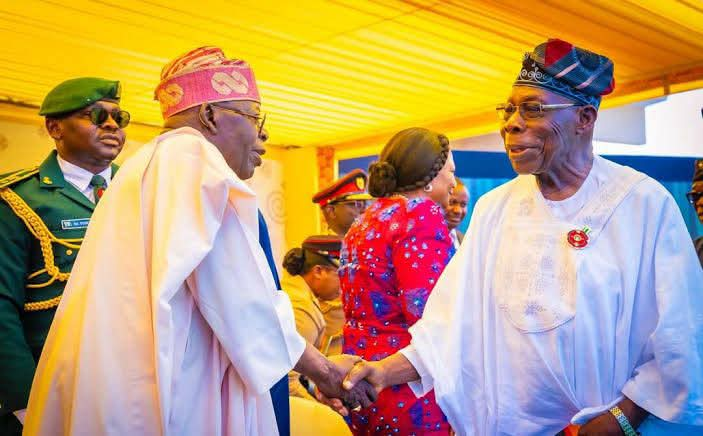
Former president faults Tinubu’s handling of fuel subsidy removal, accusing his administration of acting before preparing measures to cushion the impact of economic reforms on Nigerians. He urges voters to make careful choices ahead of the 2027 general election.
Former President Olusegun Obasanjo has launched another strong criticism of President Bola Tinubu, accusing him of assuming office without a clear plan for governing Nigeria and managing the economic challenges facing the country.
Obasanjo said the Tinubu administration’s handling of the removal of fuel subsidy exposed a lack of preparation, arguing that a responsible government should have anticipated the consequences of such a major policy decision before implementing it.
Speaking during an interview with News Central Television, the former president questioned why the government announced the removal of fuel subsidy immediately after Tinubu took office in May 2023 but waited several months before introducing palliatives to cushion the economic impact on Nigerians.
According to Obasanjo, effective leadership requires careful planning, preparation and an understanding of how major policy decisions will affect ordinary citizens.
"A serious leader studies the shock before he acts. He stocks buffers. He phases the pain so that ordinary people do not suffer at once," he said.
The former president argued that Nigeria experienced the opposite under Tinubu, describing the government's approach as one in which announcements came before proper planning.
"What Nigeria got was a slogan first, and a scramble second," Obasanjo said.
He also questioned the three-point agenda of the Tinubu administration, demanding clarity on who designed the policy framework, the objectives it was intended to achieve and how it was expected to address the country's challenges.
Obasanjo maintained that the economic difficulties Nigerians have endured since Tinubu assumed office were not entirely unexpected but reflected the consequences of implementing major reforms without adequate preparation.
He pointed to the rising cost of food, transportation and fuel, alongside the pressure on household incomes, as evidence of the hardship associated with the government's economic decisions.
The former president stressed that removing fuel subsidy was not simply a matter of making a policy announcement, insisting that governments must consider the immediate consequences for citizens and put adequate protection measures in place.
"A prepared president does not announce 'Subsidy is gone' on day one and invent palliatives months later," he said.
Obasanjo Warns Nigerians Ahead of 2027 Elections
Beyond his criticism of the administration's economic policies, Obasanjo urged Nigerians to carefully consider the country's future when they head to the polls in the 2027 general election.
He said voters must reflect deeply on the qualities they expect from the next phase of leadership, stressing that their decisions would have far-reaching consequences for the country's direction.
According to him, Nigerians should look beyond political slogans and campaign promises when choosing their leaders, placing greater importance on competence, preparation, clear policies and the ability to protect citizens from economic shocks.
Obasanjo has repeatedly expressed concerns about Tinubu's leadership and the direction of the country since the president assumed office.
His latest remarks represent another pointed assessment of the administration, particularly its approach to economic reforms and the management of the hardship that followed the removal of fuel subsidy.
The former president's central argument is that leadership goes beyond announcing ambitious policies. It requires anticipating challenges, preparing solutions and ensuring that ordinary citizens do not bear the full burden of government decisions.
Leave a comment
Your email address will not be published. Required fields are marked *