

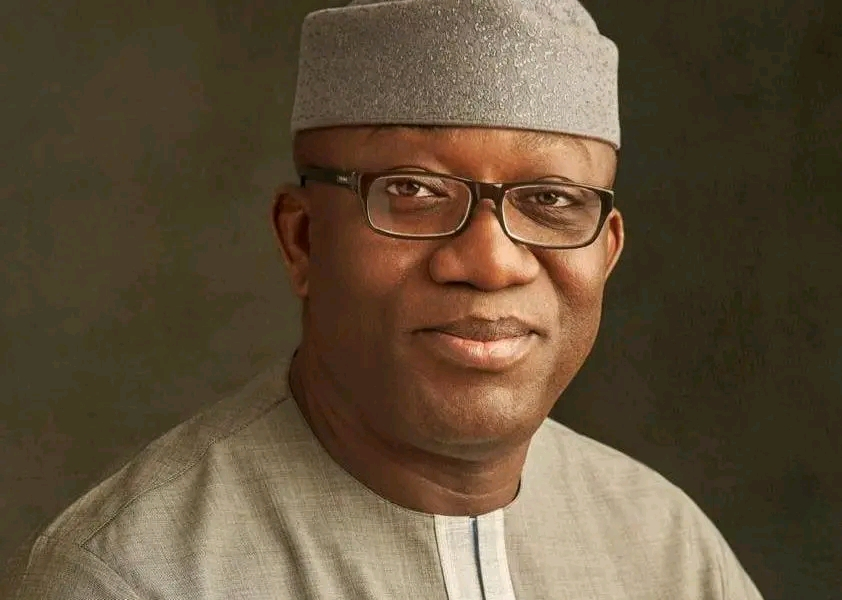
Former Ekiti governor says ADC presidential candidate is seeking to exploit public hardship caused by subsidy removal, while insisting he still supports the policy in principle.
Former Governor of Ekiti State, Kayode Fayemi, has described African Democratic Congress (ADC) presidential candidate Atiku Abubakar’s promise to reinstate fuel subsidy as a political strategy designed to appeal to Nigerians struggling with the effects of subsidy removal.
Fayemi made the comment during an interview on Arise News, where he compared Atiku’s subsidy proposal to the All Progressives Congress (APC) decision to field a Muslim-Muslim presidential ticket in the 2023 general election.
According to the former governor, Atiku’s proposal may have significant political appeal among Nigerians who have been adversely affected by the removal of petrol subsidy, but he argued that it should not be mistaken for a comprehensive economic solution.
“Frankly, my take on that is that Atiku’s proposal on subsidy is the political equivalent of our own Muslim-Muslim ticket in 2023. It is a political strategy. It’s not an economic construct, but understandably, it is a political strategy that will sell with those who are hard done by the impact of full subsidy removal,” Fayemi said.
Atiku, who is seeking the presidency under the ADC ahead of the 2027 election, has repeatedly said he would restore fuel subsidy if elected, arguing that government intervention is necessary to reduce the burden of rising petrol prices on Nigerians.
President Bola Tinubu removed the petrol subsidy shortly after assuming office in May 2023. In his inaugural address, Tinubu announced that “fuel subsidy is gone,” triggering a sharp increase in petrol prices and transportation costs across the country.
The policy has remained one of the most contentious economic decisions of the Tinubu administration. While the Federal Government has maintained that subsidy removal has freed resources for infrastructure, social programmes and other areas of development, households and businesses have faced increased living costs.
Fayemi, however, stressed that he was not opposed to subsidy removal and said he had personally advocated for the policy during his years as chairman of the Nigeria Governors’ Forum.
“I was and I remain an advocate of full subsidy removal. As chairman of the governors’ forum, I spent four years in this battle,” he said.
He added that Tinubu inherited a situation in which much of the groundwork for subsidy removal had already been undertaken by the previous administration.
“What President Tinubu inherited, in fairness to him, was the work that had already been completed by that administration,” Fayemi said.
However, he faulted the manner in which the policy was implemented, although he acknowledged that Tinubu could argue that delaying the decision would have made it more difficult to execute.
“The only challenge I had was the way it was done. But then again, he might argue that if he had left it much later than the immediate removal that he did, he probably wouldn’t have been able to do it,” he said.
Fayemi said the major concern surrounding subsidy removal should be how its impact on vulnerable Nigerians is managed.
He recalled that the Nigeria Governors’ Forum had worked with the Federal Government and the World Bank on a safety-net strategy intended to cushion the effect of subsidy removal on the poorest and most vulnerable Nigerians.
“I am not in any way opposed to the decision to remove fuel subsidy. However, as I have also consistently said, because at the Nigerian Governors Forum, we actually had a committee work with the federal government and the World Bank, by the way, to develop a safety net strategy that would address what will happen to the most vulnerable segment of our population,” he said.
The former governor suggested that the political consequences of the subsidy policy had created an opportunity for opposition politicians ahead of the 2027 election.
He argued that Atiku’s promise to reverse the policy was aimed at capitalising on the dissatisfaction of Nigerians who have borne the immediate economic consequences of subsidy removal.
Fayemi likened this to the strategy adopted by the APC in 2023, when the party defended its decision to present a Muslim-Muslim presidential ticket as a means of maximising its electoral prospects.
“So I think the way we saw the Muslim-Muslim ticket as a political strategy, in order to maximise the vote for our party in 2023, I believe that’s what the opposition candidate is also trying to take advantage of,” he said.
Atiku’s subsidy pledge is expected to remain a major issue in the 2027 presidential contest, particularly as political parties seek to respond to concerns over the rising cost of living.
The debate is likely to centre on whether petrol subsidies represent a sustainable economic policy or a necessary intervention to protect Nigerians from the immediate effects of high energy costs.
While Fayemi supports the removal of subsidy in principle, his comments highlight the political challenge facing the Tinubu administration: convincing Nigerians that the long-term benefits of the policy will outweigh the immediate economic pain experienced by millions of households.
Leave a comment
Your email address will not be published. Required fields are marked *