

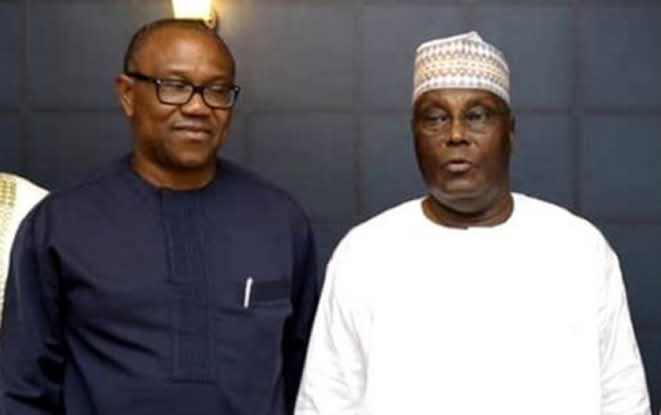
Movement for Credible Elections says closed-door consultations with shortlisted opposition presidential candidates and party leaders will seek consensus on a candidate and a common governance agenda ahead of the 2027 election.
Professor of Political Economy, Pat Utomi, is set to lead a series of consultations with major opposition presidential candidates and their party leaders as part of efforts to develop a single-candidate arrangement ahead of Nigeria’s 2027 presidential election.
The initiative is being coordinated by the Movement for Credible Elections (MCE), which said the consultations would focus on finding a broadly acceptable candidate capable of leading a united opposition platform against President Bola Tinubu and the All Progressives Congress (APC).
According to the MCE, the meetings will be held behind closed doors and are expected to be concluded within two weeks before a tactical session scheduled to take place in Ibadan.
The development was disclosed in a statement issued by the MCE Media Coordinator, James Ezema.
The statement said the consultations were designed to address one of the major challenges that has affected previous opposition coalition efforts—reaching an agreement on who should lead a proposed alliance after parties and politicians have agreed in principle to work together.
Atiku, Obi, Makinde, Sowore, Others Listed
The MCE said the Utomi-led Political Commission would engage several presidential candidates and opposition figures as part of the process.
Those listed include former Vice President Atiku Abubakar of the African Democratic Congress (ADC), former Anambra State Governor Peter Obi of the Nigeria Democratic Congress (NDC), Adewole Adebayo of the Social Democratic Party (SDP), Seyi Makinde of the Allied People’s Movement (APM), Donald Duke of the Peoples Redemption Party (PRP), Sandy Onor of the Peoples Democratic Party (PDP), Peter Agada of the Young Progressives Party (YPP), and Omoyele Sowore of the African Action Congress (AAC).
The MCE said the closed-door nature of the meetings was intended to protect the negotiations from interference and what it described as sabotage by individuals opposed to the coalition initiative.
It said the process was not simply about bringing politicians together but about establishing a workable mechanism for choosing a candidate and developing a common political programme.
MCE Sets Criteria for Consensus Candidate
The movement said the selection of a consensus candidate would be guided by principles including credibility, transparency, fairness, due process and a level playing field.
It said the participating candidates and political parties would have to agree on the modalities and conditions under which the eventual candidate would be endorsed.
Among the proposed criteria for assessing the candidates are national acceptability, competence, integrity, leadership profile, political electability, policy orientation and commitment to democratic institutions.
The process would also consider each candidate’s capacity to unite Nigerians, work with diverse social interests and demonstrate an understanding of the country’s political, democratic and constitutional challenges.
The MCE said the process would not be limited to selecting a presidential candidate.
According to the organisation, the proposed coalition would also develop a common national programme covering key issues affecting Nigerians, including insecurity, economic hardship, unemployment, poverty, institutional weaknesses, electoral reforms, constitutional reform, education, healthcare, energy and the cost of governance.
‘Coalition Must Be More Than Personalities’
The movement said Nigerians should be offered a political alternative based on ideas, policies and governance principles rather than an arrangement built solely around individual politicians.
“The Nigerian people deserve more than a coalition of political personalities. They deserve a coalition of ideas, competence, values and a coherent ideological programme for national salvation,” the MCE said.
It stressed that its role was to facilitate negotiations rather than impose a candidate on any party or presidential aspirant.
The organisation also said political negotiations would require participating politicians to make compromises and accept that no single individual or party could independently provide the broad opposition platform being contemplated.
Candidates May Have to Accept Outcome
A major condition proposed by the MCE is that every participating presidential candidate and political party would commit beforehand to respecting the outcome of the consensus process.
The organisation said those who participate would be expected to support the candidate eventually adopted by the coalition in the 2027 presidential election.
The proposal is aimed at preventing a repeat of opposition arrangements where politicians participate in negotiations but withdraw when the process produces a candidate other than themselves.
The MCE said the ultimate objective was to create what it described as a credible, people-oriented governance alternative rather than simply replacing one political arrangement with another.
Other Opposition Coalition Efforts
The MCE initiative comes amid several attempts to bring Nigeria’s opposition parties and politicians into a common platform ahead of the 2027 general elections.
In August, a group of 100 Nigerians under the banner of G100 called on opposition leaders to set aside individual ambitions and negotiate a unified electoral arrangement based on a single presidential candidate, a common programme and a coordinated strategy.
The group’s “Doctrine of a Necessary Democratic Opposition” appealed to opposition figures including Atiku Abubakar, Peter Obi, Seyi Makinde, Bala Mohammed, Seriake Dickson, Rotimi Amaechi, Rabiu Kwankwaso and Rauf Aregbesola to prioritise broader national interests in their negotiations.
The G100 subsequently held consultations with several opposition parties, including the ADC, APM, NDC, PDP, PRP and SDP.
The MCE said its own consultations would involve Utomi alongside Maryam Ciroma, Modupe Adelaja, Solomon Dalung, Uche Onyeagocha, Olusegun Mayegun, Sam Amadi, Mike Iginni, Obongawan Barbara Etim James, Olawale Okunniyi and Dr Adum Ter Alex, among others.
The movement urged all stakeholders to enter the negotiations with an open mind and place the country’s democratic future ahead of personal political interests.
The consultations are expected to provide another test of whether Nigeria’s opposition parties and presidential aspirants can agree on a common candidate and a shared political programme before the 2027 presidential election.
Leave a comment
Your email address will not be published. Required fields are marked *