

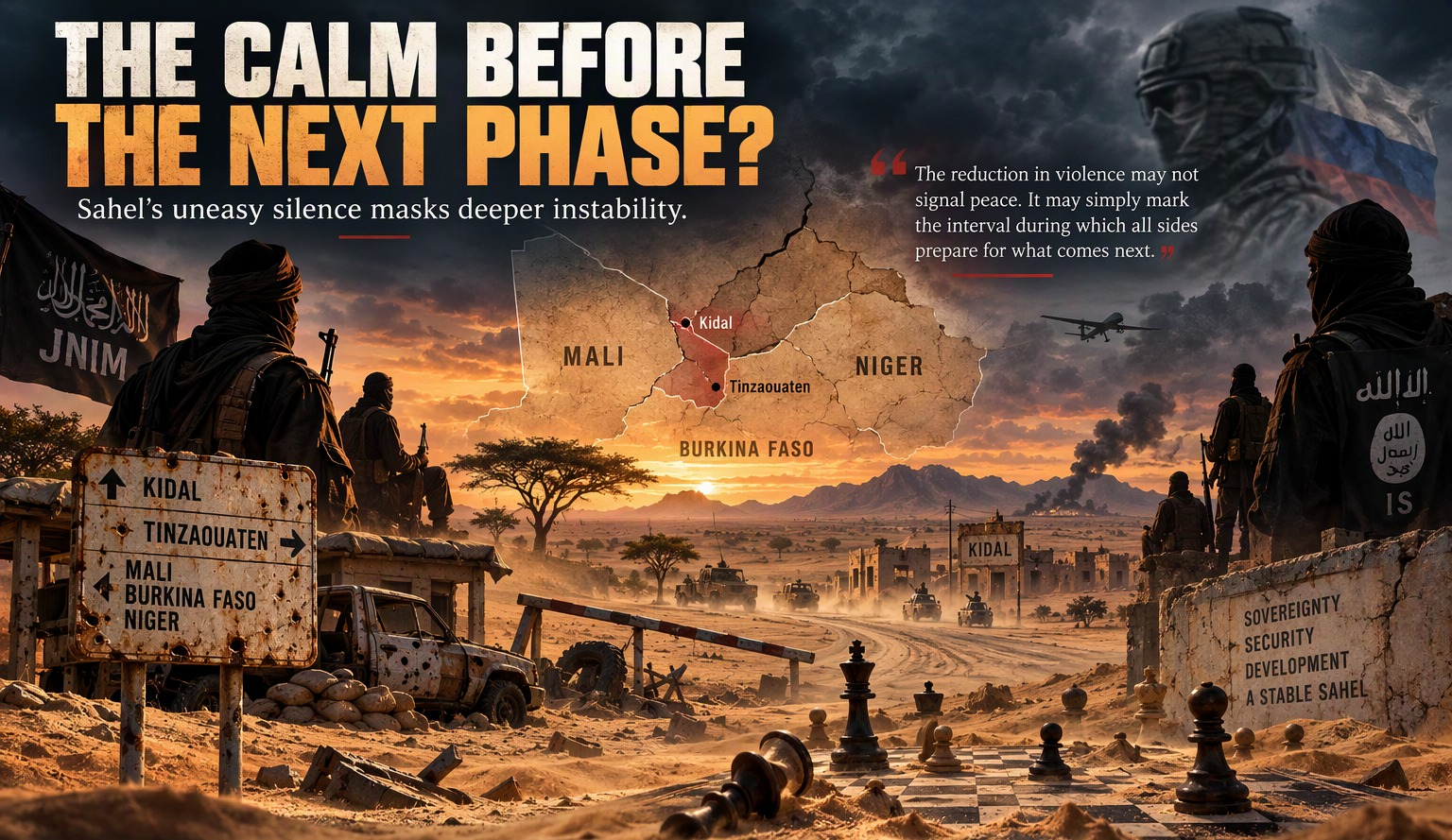
A decline in violence across the Mali-Burkina Faso-Niger borderlands is raising hopes of stability, but jihadist rivalries, unresolved local grievances and mounting challenges facing Russian-backed forces suggest the apparent calm may be a pause before another phase of conflict.
The relative quiet that has settled over the Mali-Burkina Faso-Niger tri-border region since late October has been interpreted by some as a welcome pause after months of relentless violence. Fighting between Jama'at Nasr al-Islam wal-Muslimin (JNIM) and the Islamic State in the Sahel (IS) has noticeably slowed, while attacks against state forces, though still continuing, appear less intense than during the preceding months.
Yet in the Sahel, calm has often preceded escalation. Beneath the surface, armed groups remain entrenched, military juntas are struggling to convert symbolic victories into lasting control, and the region's reliance on Russian security assistance is facing unprecedented scrutiny. Rather than signaling stabilization, the current lull may conceal a broader strategic reorganization that could reshape the conflict in the years ahead.
The most immediate explanation for the slowdown is the heavy toll inflicted by the growing rivalry between JNIM and IS. Throughout 2025 and 2026, both organizations have devoted considerable resources to fighting one another for influence over populations, trade routes, and recruitment networks.
These confrontations have imposed significant costs. Fighters have been lost, commanders replaced, and supply chains disrupted. Even highly adaptive insurgent organizations require periods of recuperation after sustained combat. But exhaustion should not be confused with defeat.
Neither JNIM nor IS shows signs of abandoning its strategic ambitions. Their competition is not simply military; it is political. Both seek to establish themselves as the dominant armed actor in large swathes of the Sahel, capable not only of conducting attacks but of governing territory where state authority has collapsed.
A temporary decline in operations may therefore represent a period of consolidation rather than decline. The current pause also comes at a sensitive moment for the military authorities in Mali, Burkina Faso, and Niger. Since expelling Western partners and presenting themselves as defenders of national sovereignty, the juntas have consistently highlighted territorial gains and military offensives as evidence that their security strategy is working. The recapture of Kidal in November 2023 became the most visible symbol of this narrative.
Supported by Wagner forces, Malian troops re-entered the city after nearly a decade of separatist control, allowing Bamako to proclaim the restoration of state authority over all regional capitals. The operation was celebrated by the junta as proof that the departure of French forces and the turn toward Russia had succeeded where previous approaches had failed.
For a moment, Kidal appeared to vindicate the new security doctrine. However, military history in the Sahel has repeatedly demonstrated that capturing territory is easier than controlling it.
The Malian state regained the city, but not necessarily the surrounding political environment. Large rural areas remained contested, insurgent networks adapted, and resentment among local communities persisted. The symbolic value of Kidal exceeded its practical impact. What appeared to be a strategic breakthrough increasingly resembles a tactical success that failed to fundamentally alter the balance of power.
The challenges became more visible after the battle of Tinzaouaten in July 2024. In one of the most significant setbacks suffered by Russian personnel in Africa, a joint Malian-Wagner convoy was ambushed near the Algerian border. Tuareg fighters, alongside actors linked to the broader insurgent ecosystem, inflicted heavy losses on government and Russian forces. Multiple reports described the battle as Wagner's most severe defeat since its deployment in Mali.
The significance of Tinzaouaten extended beyond the battlefield. For years, Russia's appeal in the Sahel rested on a simple promise: unlike Western partners constrained by political conditions and human-rights scrutiny, Moscow would provide decisive military support capable of reversing insurgent momentum.
The battle revealed that despite superior firepower, drones, and external support, state forces still struggled against highly mobile insurgent formations operating in familiar terrain. Analysts increasingly viewed the defeat as a challenge to Russia's broader African strategy and a setback for its effort to replace French influence across the region.
The situation has only intensified since. In 2026, reports emerged of Russian-linked Africa Corps elements withdrawing from positions in Kidal following renewed insurgent pressure. Observers described the retreat as a major reputational blow for Moscow's security project in Africa, particularly because Kidal had been presented as a flagship success only a few years earlier.
This creates a difficult paradox for the Alliance of Sahel States (AES). The juntas have largely succeeded in reclaiming the language of sovereignty. Anti-French sentiment remains politically useful, and the assertion of national independence continues to resonate with domestic audiences.
Yet sovereignty is not measured solely by control of capitals or military bases. It is measured by the state's ability to secure transport corridors, regulate economic activity, provide public services, and maintain a permanent presence in remote areas. On these indicators, armed groups continue to demonstrate remarkable resilience.
Indeed, the current lull may partly reflect an uncomfortable reality: jihadist organizations no longer need constant offensive operations to expand their influence. In many regions, they have embedded themselves within local governance structures, taxation systems, and community relations. Their power increasingly derives from social penetration as much as military capacity.
The apparent calm has also revived speculation about local accommodations between authorities and armed actors. Several prisoner exchanges, reductions in hostilities along specific routes, and reports of informal contacts have fueled questions about whether tactical understandings have emerged between state representatives and insurgent factions.
Such arrangements would not be unprecedented. Across conflict zones, temporary non-aggression pacts often arise when neither side possesses the capacity to achieve decisive victory. For governments, these arrangements can reduce immediate security pressures. For insurgents, they provide opportunities to regroup, recruit, and consolidate influence.
They do not resolve conflicts. They merely postpone them. The greatest danger is misreading the current moment. The reduction in violence may reflect battlefield exhaustion. It may indicate tactical adaptation. It may result from localized accommodations. Most likely, it combines all three.
What it almost certainly does not represent is the disappearance of the threat. The jihadist organizations remain active. Separatist grievances remain unresolved. State authority remains uneven. And the Russian-backed security model that promised to transform the conflict is increasingly facing the same structural obstacles that undermined previous international interventions.
The silence settling over the Sahel should therefore be approached cautiously. Kidal demonstrated that symbolic victories can coexist with deeper instability. Tinzaouaten showed that military partnerships alone cannot guarantee control. The current calm may not be evidence that the conflict is ending. It may simply mark the interval during which all sides are preparing for its next phase.
Amajama, a social and policy analyst, writes from Abuja and can be reached via amajamaip@gmail.com
Leave a comment
Your email address will not be published. Required fields are marked *