

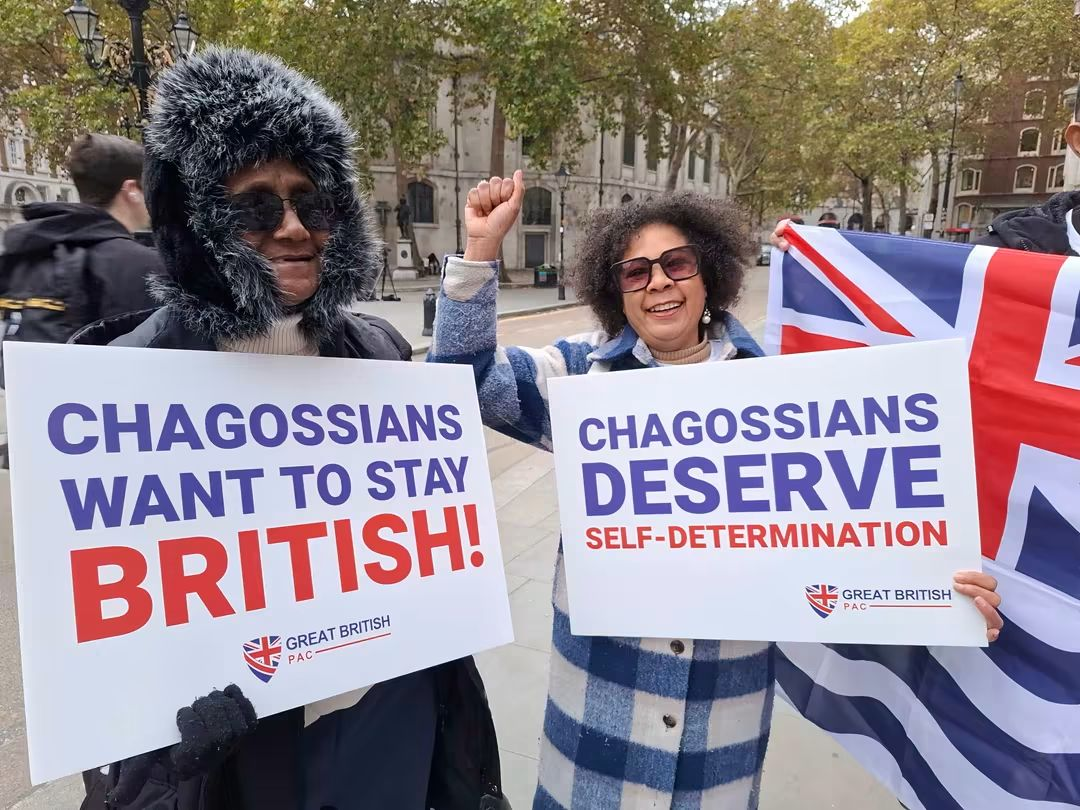
The British Court of Appeal has rejected a fresh attempt by Chagossians living in the UK to challenge the government’s refusal to reconsider restrictions preventing their return to the Chagos Islands, despite renewed resettlement prospects under the proposed UK-Mauritius agreement.
The long-running struggle by Chagossians to return to their ancestral homeland has suffered another legal setback after the British Court of Appeal refused to hear a fresh challenge against the UK government's refusal to reconsider restrictions on their right to settle in the Chagos Islands.
The decision, delivered on Friday, November 20, 2026, by Lady Justice Andrews, rejected the application brought by several Chagossians, including Louis Michel Mandarin, his son, Louis Misley Mandarin, and activist Bertrice Pompe, according to the Conservative Post.
The applicants had argued that significant developments had taken place since the restrictions were introduced in 2004, making it necessary for the British government to review its position on the right of Chagossians to return home.
Central to their argument was the proposed agreement between the United Kingdom and Mauritius, which provides for the possibility of resettling Chagossians on islands within the archipelago other than Diego Garcia, the strategically important island hosting a major UK-US military base.
However, Lady Justice Andrews found that most of the applicants' arguments challenged the government's decision-making process surrounding the proposed sovereignty agreement, rather than establishing a legal basis for compelling a review of the existing restrictions.
The judge also ruled that the applicants had failed to demonstrate that the British government was under a legal obligation to reconsider the restrictions imposed in 2004.
The ruling does not amount to judicial approval of the proposed transfer of sovereignty to Mauritius, nor does it determine whether the arrangement is politically justified. Rather, it addresses the specific legal grounds presented by the applicants.
Decades-long struggle for the right to return
The Chagossians were forcibly removed from their homeland during the 1960s and 1970s after Britain established the British Indian Ocean Territory (BIOT) and cleared the way for the construction of a major military facility on Diego Garcia.
Thousands of islanders and their descendants were displaced, with many settling in Mauritius, Seychelles and the United Kingdom.
Despite decades of campaigning, legal battles and international pressure, the community has continued to face restrictions preventing them from permanently returning to live in their ancestral territory.
The latest court decision represents another obstacle for those who have spent years seeking justice and recognition of their right to return.
Mauritius-UK sovereignty deal remains unresolved
The legal battle is unfolding against the backdrop of the proposed agreement between Mauritius and the United Kingdom over the future of the Chagos Archipelago.
The treaty, signed on May 22, 2025, provides for the transfer of sovereignty over the archipelago to Mauritius, while allowing the United Kingdom and the United States to maintain their military presence on Diego Garcia under a long-term arrangement.
However, the agreement has not yet been ratified.
The prime ministers of both countries have also agreed to work towards a joint plan by the end of the year, adding another layer of uncertainty to the future of the archipelago and the prospects for Chagossian resettlement.
Another legal reversal adds to uncertainty
The latest setback follows another significant development on November 12, 2026, when the BIOT Court of Appeal overturned a March ruling that had declared the constitutional prohibition on the right of residence illegal.
The reversal further complicates the Chagossians' efforts to secure a legal pathway back to their homeland.
Representatives of the Chagossians are now considering whether to challenge the latest developments before the United Kingdom's Privy Council, potentially opening another chapter in their decades-long legal struggle.
For many Chagossians, the fight is about more than territorial sovereignty or political agreements. It is about the right to return to the land from which their families were forcibly removed and to rebuild a connection with a homeland that generations have been unable to call home.
Leave a comment
Your email address will not be published. Required fields are marked *