

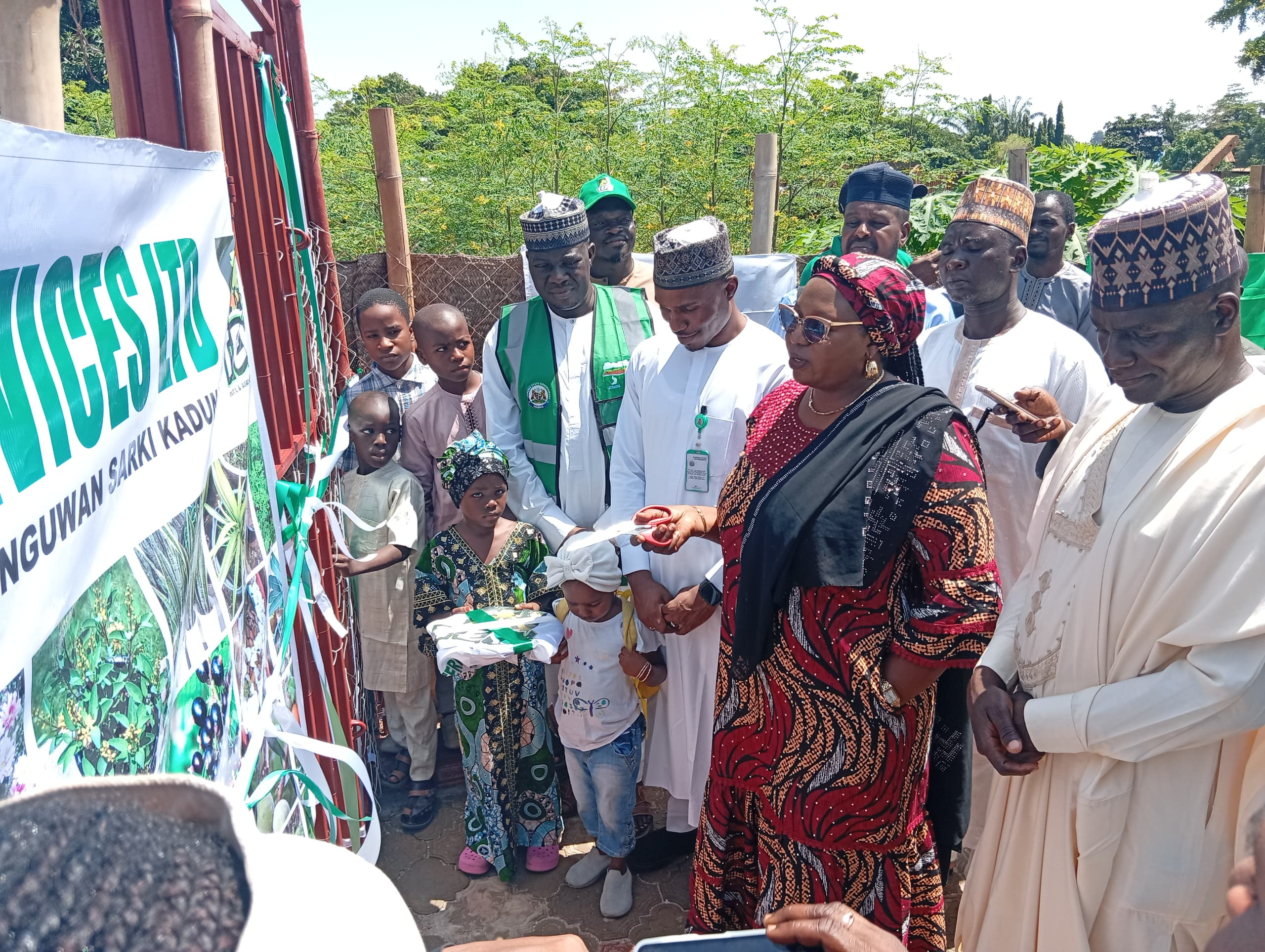
State government partners with ACReSAL and Teku Farms to boost climate resilience, expand tree planting and equip youths and women with modern farming skills.
The Kaduna State Government on Tuesday flagged off the distribution of 10,000 seedlings to schools and institutions and unveiled a new policy that makes green areas compulsory for building permit approval, as part of efforts to hit its 10 million trees target and strengthen climate resilience.
The event held at Teku Farms International and Agro Allied Services Limited, which is partnering with the state to provide the seedlings. It also served as the formal opening of the farm’s new agricultural training centre focused on equipping women and young people with modern farming techniques.
The Permanent Secretary, Ministry of Environment and Natural Resources, Linda Yakubu, said the partnership aligns with the ACReSAL project’s mandate on climate mitigation and resilience in semi-arid landscapes.
She said government deliberately targeted institutions because they are better placed to nurture trees to maturity and ensure survival. Also present were the Senior Special Assistant to the Governor on Lands, directors of the ministry, and representatives of ACReSAL.
Yakubu stressed that sustainability will depend on catching children early through agriculture and horticulture training. She described Teku Farms’ training arm as a “very noble idea” that must be sustained, adding that when pupils adopt good environmental practices early, they grow to appreciate nature and understand the effects of climate change.
She noted that the ministry has in previous years raised nurseries and distributed seedlings to schools, and expects the Ministry of Education to collect more seedlings from the current batch for planting in institutions across the state.
The Permanent Secretary announced that the Ministry of Environment, the Ministry of Housing, and the Kaduna State Urban Planning and Development Authority, KASUPDA, will now work together to enforce the green area requirement for all new buildings in Kaduna.
Beyond institutions and communities, she said the campaign is being taken to households, with an appeal to every home to plant at least one tree.
The initiative builds on investments already made by the state government and by the ACReSAL project in raising nurseries for schools, worship centres, communities and homes.
Yakubu also shared a personal commitment to the drive, saying she now plants trees, flowers and fruit seedlings at her home, including apple seedlings collected from Teku Farms.
She warned against indiscriminate tree felling and said ministry officials have been directed to intervene where necessary. “Mitigating climate change is basically nature-based, and nature has provided. One of the best ways is to plant trees,” she said.
Also speaking, the Founder and Proprietor of Teku Farms International and Agro Allied Services Limited, Mallam Ibrahim Salisu, said the new agricultural training centre was opened to equip women and young people with modern farming techniques aimed at creating jobs and boosting food production in Nigeria.
“The facility, which commenced operations with both young men and women in training, is positioning itself as an alternative pathway to employment at a time when thousands of graduates remain jobless,” he said.
“For generations, our parents and grandparents practised farming with basic tools, without sufficiently modernising the practice. That has limited the sector’s potential,” a coordinator at the farm said. “Agriculture can be developed into a profitable business and can provide employment opportunities for young people if we embrace modern methods.”
The launch comes amid rising youth unemployment. Organisers said they are particularly concerned about educated young people “sitting idle after completing their studies, with little to do other than move from one ministry to another carrying applications in search of employment.”
They argued that government alone cannot absorb the growing number of job seekers entering the labour market each year.
“The government cannot provide jobs for the large number of young people entering the labour market. We therefore need to create opportunities for ourselves, while the government supports and enables us,” the coordinator added.
Mallam Ibrahim explained that Teku Farms’ training model is designed to debunk the notion that farming is laborious and unrewarding. Using demonstration plots, instructors are teaching participants how to achieve significant yields and generate substantial income from even small parcels of land through modern techniques.
“Agriculture, when properly modernised and supported, can become a powerful tool for employment, economic empowerment and sustainable development for women and young people,” the farm stated.
He noted that agriculture remains a heritage passed down by parents and grandparents, particularly in Northern Nigeria, but the sector has been held back by reliance on traditional tools such as the hoe and slow adoption of technology.
Stakeholders at the event described the initiative as timely, saying the inclusion of women and youth is critical to transforming agriculture from subsistence to agribusiness in Nigeria.
The centre is expected to run regular training programmes and provide practical support to graduates who want to start their own farms.
Leave a comment
Your email address will not be published. Required fields are marked *