

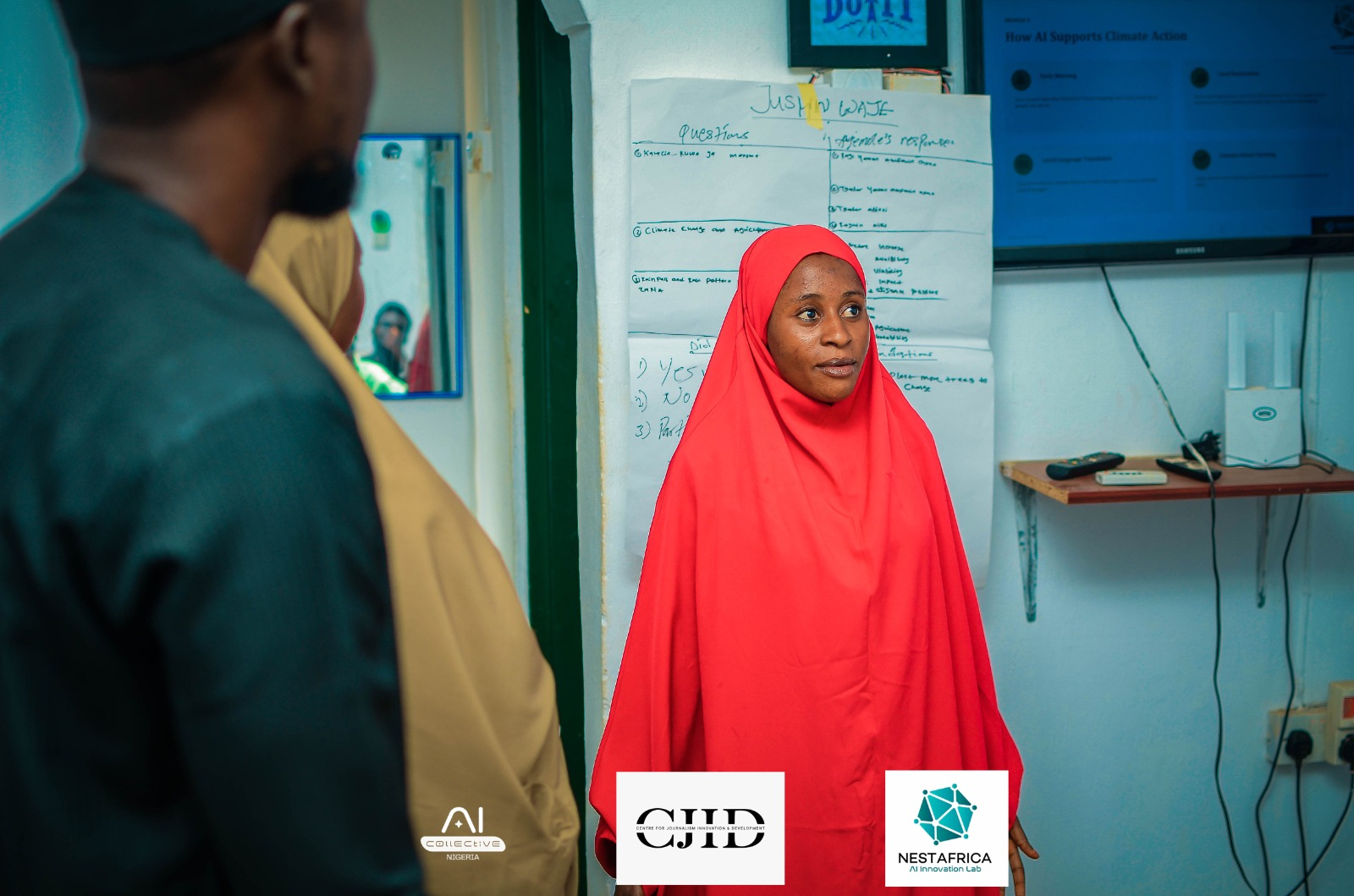
Twenty young farmers trained as AI Climate Youth Ambassadors are using localised technology to provide early warnings on floods, soil degradation and other climate risks across three communities in Sabon Gari LGA.
In three farming communities in Sabon Gari Local Government Area, young people are now using artificial intelligence to warn neighbours about floods and deteriorating soil, months before the damage becomes severe.
The effort is led by Nest Africa AI Innovation Lab, which recently trained 20 young farmers as AI Climate Youth Ambassadors. The one-day workshop held in Zaria brought together participants from Jushi, Jama’a and Zabi wards.
They were chosen not because they had tech degrees, but because they already understand the land. Organisers said that lived experience of seasonal risks in Northern Nigeria could not be taught in a classroom.
This is contained in a statement signed by Muhammed Sani Kabir, Communications Lead, he said
The tool at the centre of the project is AyéMọlẹ AI. The climate intelligence platform, built by Nest Africa, turns complex weather and environmental data into simple, local language guidance that works on basic mobile phones.
For many Nigerians, AI still means a chatbot that answers homework questions. But in Kaduna, the Lab is trying to change that perception by connecting AI directly to the problems farmers face every season.
The connection is urgent. According to ReliefWeb, floods in 2022 affected more than 3 million people in Nigeria and destroyed over 500,000 hectares of farmland. In many northern communities, soil degradation has been cutting yields quietly year after year.
The project, titled “Demystifying AI in Practice: Community Awareness and Climate Intelligence in Kaduna,” is supported by the Centre for Journalism Innovation and Development under the Nigeria AI Collective.
The Collective was set up by the Federal Ministry of Communications, Innovation and Digital Economy and is led by Data Science Nigeria, Lagos Business School and CJID. Nest Africa was one of seven civil society groups selected to translate the national AI mandate into community action.
What makes AyéMọlẹ AI different is its design for rural realities. It does not require constant internet or technical English. Instead of just saying “it will rain,” it tells a farmer what that rain means for planting, grazing, or moving livestock out of a floodplain.
During the training, facilitators mixed lessons on AI basics, climate change and land degradation with role-play and ward breakout sessions. Participants tested the platform using real problems from their own farms.
The results were clear. Average knowledge scores rose from 74.3 percent before the training to 94.5 percent after. The biggest gain was on land degradation. Only 38.1 percent could define it correctly at the start. By the end, 95 percent could, and 100 percent knew how to reduce it.
“Awareness gaps are often about vocabulary and framing rather than a lack of lived knowledge,” said Abubakar Isa Abubakar, one of the facilitators. “That is why community-level sensitization with farmers and land users matters so much.”
Each ambassador left with a commitment to train at least 25 more farmers in their ward. The cascade model is designed to extend the reach to 150 or more additional people, well beyond the original 20.
The team has already taken the platform back to the three communities. Through awareness sessions and live demos, an estimated 100 to 150 residents, including farmers, interacted with AyéMọlẹ AI directly and gave feedback to the technical team.
The conversations also went beyond climate. Many residents began asking what else AI could be used for, a sign that the project is shifting how people see the technology, from novelty to practical problem-solving.
Nest Africa has also started talks with policymakers. Initial discussions have been held with the Kaduna State Emergency Management Agency. Further engagement is planned with the Ministries of Agriculture and Environment, and local government authorities. A policy brief is being prepared ahead of a stakeholder roundtable.
With youth making up more than 60 percent of Nigeria’s population and northern states facing growing climate risk, the Kaduna pilot offers a model that other states could copy. It is low-cost, mobile-first, and relies on trust and peer learning rather than top-down campaigns.
Nest Africa AI Innovation Lab is a Kaduna-based organisation building practical AI tools for underserved communities. It was selected by CJID for an advocacy grant under the Nigeria AI Collective.
Leave a comment
Your email address will not be published. Required fields are marked *