

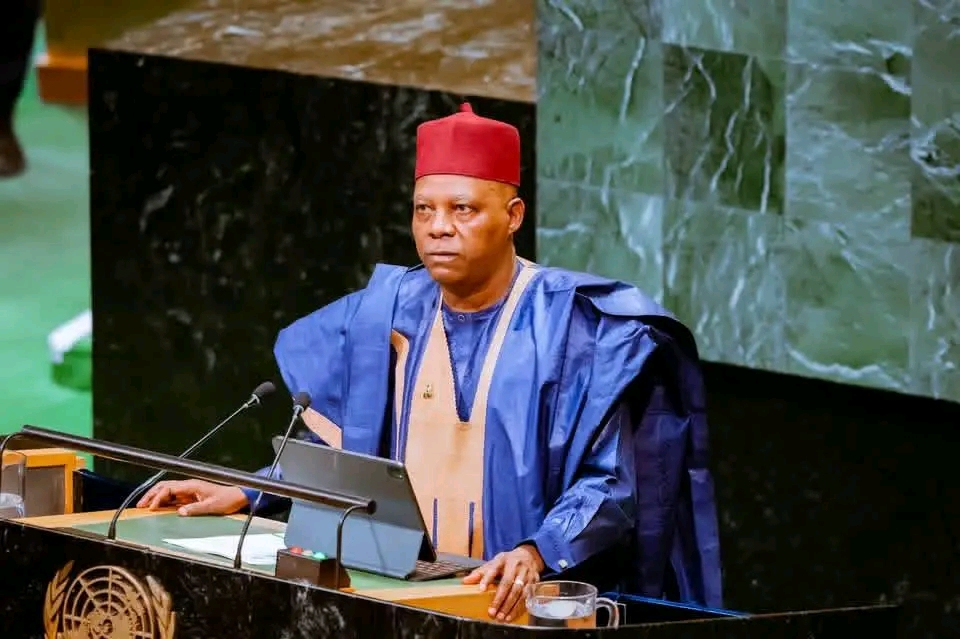
Nigeria says the current structure of the United Nations Security Council no longer reflects global realities and calls for Africa to have permanent representation with full rights.
Vice President Kashim Shettima has called for comprehensive reform of the United Nations Security Council, demanding at least two permanent seats for Africa with full membership rights, including veto power.
Shettima made the demand on Thursday in New York while delivering President Bola Ahmed Tinubu’s national statement at the 81st Session of the United Nations General Assembly (UNGA).
The Vice President said the existing structure of the United Nations no longer adequately reflects the realities of the world in 2026, particularly the political, economic and demographic significance of Africa.
According to him, Africa should no longer be left on the margins of decisions taken by the Security Council on issues affecting international peace and security.
He argued that the international community could not continue to operate under a system shaped by the distribution of global power immediately after the Second World War.
“The world cannot remain captive to the distribution of power in 1945,” Shettima said, stressing the need for a more representative and equitable international system.
Nigeria is seeking at least two permanent seats for Africa on the UN Security Council, with the full rights and responsibilities attached to permanent membership.
The country also wants African permanent members to have veto power for as long as the veto remains in existence within the Security Council.
In addition, Nigeria called for Africa to receive five non-permanent seats on the Council, in line with the Ezulwini Consensus and Sirte Declaration, which articulate the African Union’s longstanding position on reform of the UN Security Council.
The demand reflects Africa’s long-running campaign for greater representation in the highest decision-making body of the United Nations.
The Security Council currently has 15 members, comprising five permanent members — China, France, Russia, the United Kingdom and the United States — and 10 non-permanent members elected for two-year terms.
The five permanent members also possess veto powers, allowing any one of them to block the adoption of substantive resolutions regardless of the level of support from other members.
African countries have repeatedly argued that the current arrangement is outdated and does not adequately represent the continent’s growing role in global affairs.
The African Union’s position, expressed through the Ezulwini Consensus and Sirte Declaration, has therefore focused on securing permanent African representation alongside additional non-permanent seats.
Nigeria’s latest position adds its voice to the broader African campaign for Security Council reform and a restructuring of the global governance system.
Shettima’s call also comes at a time when debates over reform of major international institutions have intensified, with developing countries pushing for greater representation in global decision-making.
Nigeria maintains that any meaningful reform of the United Nations should address the historical imbalance in the composition of the Security Council and give Africa a stronger voice in decisions concerning international peace, security and development.
The demand places Nigeria among African countries continuing to press for the implementation of the continent’s common position on UN Security Council reform.
Leave a comment
Your email address will not be published. Required fields are marked *