

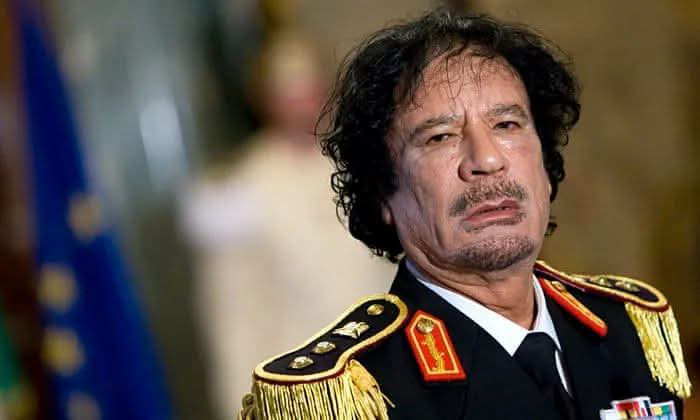
The former Abia governor says he sold arms to buyers across different countries, including Libya under Muammar Gaddafi, but eventually quit the business after his parents intervened.
Former Abia State Governor and Senator representing Abia North, Orji Uzor Kalu, has admitted that he was once involved in international arms trading, revealing that his customers included the late Libyan leader, Muammar Gaddafi.
Kalu made the revelation during an interview on Arise Television, where he spoke openly about his former involvement in the sale and movement of heavy weapons across different countries.
The senator said his primary motivation at the time was to make money, insisting that he was more concerned about the financial benefits of the business than how the weapons would eventually be used.
In a blunt response during the interview, Kalu dismissed suggestions that he was concerned about the consequences of selling arms to different buyers.
“No, no, no, no, no, no. I was selling guns to make money, whether they blow up, it’s not my business,” he said.
Kalu also clarified that his arms business was not restricted to the African National Congress (ANC), the South African liberation movement that fought against apartheid.
According to him, he was willing to sell weapons to any interested buyer who had the financial capacity, regardless of the country involved.
“No, I was selling to anybody that wants to buy. If you have the money, you want to buy in D.R.C, I sell to you, you want to buy in Namibia, you want to buy…” he stated.
When asked where he obtained the weapons, the former governor declined to provide details, describing the information as strictly private.
“It’s only my business,” he responded.
Addressing questions about the proliferation of weapons and Nigeria’s current security challenges, Kalu attempted to distinguish his former activities from the circulation of small arms.
He maintained that his transactions involved heavy weapons sold between countries rather than the small arms commonly associated with local criminal activities.
“No, these are heavy arms that were sold country to country,” he explained.
The interviewer also questioned him about whether his dealings included Libya during Gaddafi's leadership.
Kalu did not deny supplying weapons to the former Libyan leader. Instead, he reiterated that he sold arms to anyone who could afford them.
When the interviewer suggested that his response meant Gaddafi was among his customers, Kalu replied: “May his soul rest in peace. He was a good man. If you have money to buy, when I was selling, I would sell to you.”
However, he said his involvement in the business eventually came to an end after his parents intervened and demanded that he abandon the trade.
According to him, both his mother and father personally insisted that he stop selling weapons, a request he said he eventually honoured.
“But my parents, my mother, my father came and said I must stop, and I stopped,” he said.
Kalu Recounts Relationship With South African Leaders
Beyond his revelations about international arms trading, the senator also spoke about his longstanding relationships with prominent South African political figures.
He traced the relationships to his association with the late South African President, Nelson Mandela, whom he said introduced him to several influential leaders in the country's political establishment.
Among those he mentioned were former President Thabo Mbeki and incumbent President Cyril Ramaphosa.
Kalu also recounted what he described as a conversation with Mandela about the political considerations surrounding the African National Congress's leadership succession.
According to the senator, Mandela once told him that Mbeki's father had made greater contributions to the anti-apartheid struggle than Ramaphosa's father.
He said the historical contributions of their respective families influenced the ANC's decision to favour Mbeki over Ramaphosa as Mandela's successor in the party's leadership arrangement.
Kalu further disclosed that Mbeki later introduced him to another former South African president, Jacob Zuma.
He said his relationships with South Africa's political leadership had continued across different administrations, reflecting his longstanding connections with influential figures in the country's political history.
His comments on the arms trade, particularly his reference to Gaddafi, are among the most striking revelations from the television interview.
Leave a comment
Your email address will not be published. Required fields are marked *