

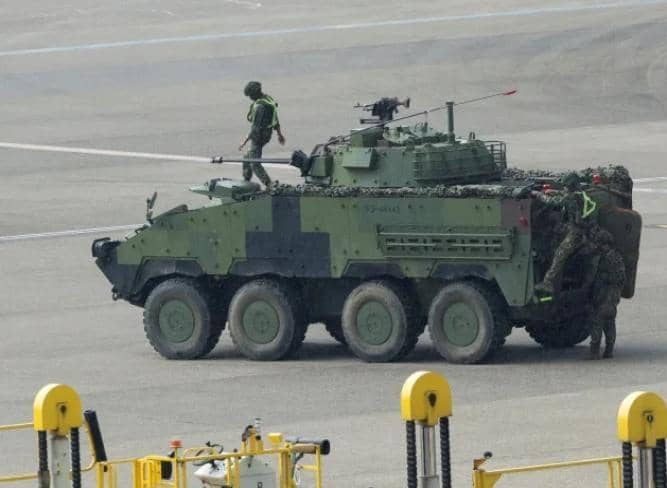
President Lai Ching-te joins emergency evacuation exercise in Taipei as 20,000 reservists mobilised amid rising tensions with China.
Taiwanese President Lai Ching-te on Wednesday took part in a high-level military exercise simulating an emergency evacuation in the event of a “decapitation strike” targeting the island’s leadership.
The drill, held in Taipei as part of the annual Han Kuang military exercises, tested the government’s ability to maintain command and safeguard national security during a potential invasion.
During the exercise, an armoured personnel carrier transported Lai and senior officials from the Presidential Office to a fortified command centre near the Ministry of National Defence.
According to the Presidential Office, the operation reviewed emergency command structures, inter-agency coordination, and continuity plans to ensure the government can function effectively during a national crisis.
The evacuation drill, known as the Wan Chun exercise, forms part of Taiwan’s largest annual military training programme and is designed to prepare the country’s leadership for wartime scenarios.
Officials said the exercise reflects growing security concerns as Chinese President Xi Jinping continues to assert Beijing’s claim over Taiwan and has not ruled out the use of force to bring the self-governing island under its control.
As part of the broader 10-day Han Kuang exercises, about 20,000 reservists were mobilised to defend key infrastructure, including ports, bridges, and power facilities.
Troops also rehearsed defensive operations at the strategically important Danjiang Bridge, while advanced air defence systems, including Patriot missiles, were deployed across Taipei to strengthen readiness.
Taiwanese defence officials said this year’s drills have taken on greater urgency following recent global conflicts that highlighted the vulnerability of national leadership during wartime.
They stressed the exercises are designed to prepare for real-world threats rather than hypothetical scenarios, amid increasing military pressure and frequent Chinese military operations around the island.
Authorities also announced plans to test Taiwan’s digital resilience next week by deliberately slowing mobile internet speeds to assess how citizens and emergency services would communicate during disasters or a potential military conflict.
The measures form part of Taiwan’s broader strategy to enhance national preparedness against evolving security challenges.
Leave a comment
Your email address will not be published. Required fields are marked *