

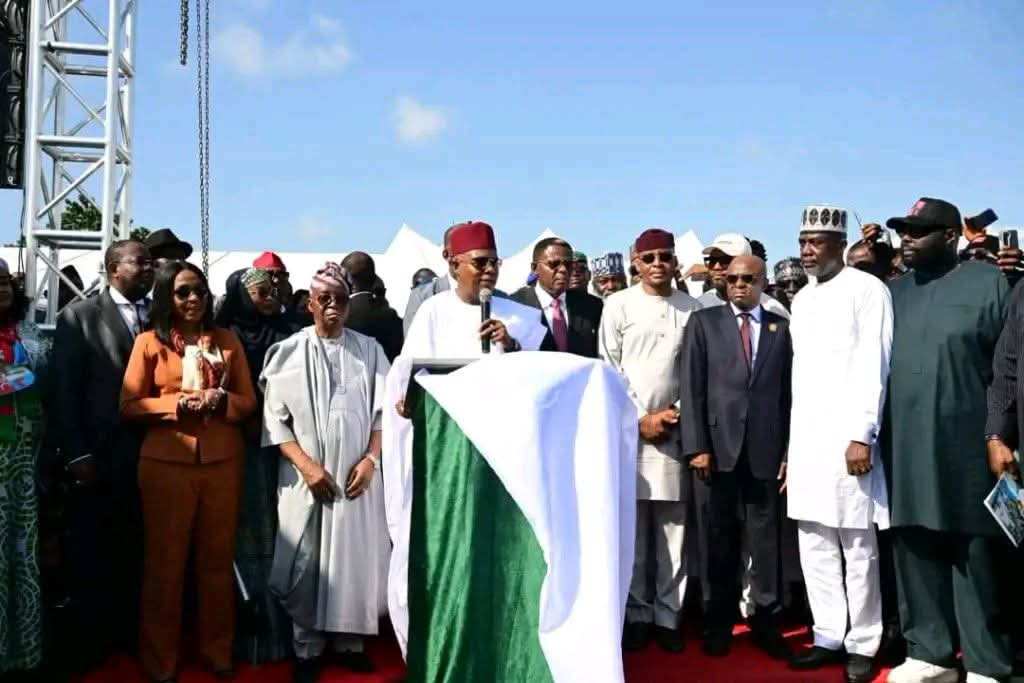
President says the proposed deep seaport will ease pressure on Lagos ports, attract industries, open new commercial corridors and strengthen Nigeria’s position in regional and international maritime trade.
President Bola Tinubu has officially flagged off the construction of the Bakassi Deep Seaport in Cross River State, describing the multibillion-dollar project as a strategic national investment that could transform Nigeria’s maritime sector, attract industrial development and create thousands of employment opportunities.
Tinubu, represented by Vice-President Kashim Shettima, spoke on Friday at the groundbreaking ceremony in Bakassi, where he said the proposed port would unlock new economic opportunities, expand commercial activities and strengthen Nigeria’s competitiveness in international trade.
The President described the project as more than a regional infrastructure initiative, insisting that its economic benefits would extend beyond Cross River State to other parts of the country.
“This is beyond a Cross River dream. It is a Nigerian project. It is a poverty breaker,” he said.
According to Tinubu, the Bakassi Deep Seaport would help address the concentration of maritime activities around Lagos by providing an additional gateway for international cargo and reducing pressure on existing port facilities.
He noted that Lagos currently handles more than 80 per cent of Nigeria’s foreign trade, arguing that the country needed additional functional seaports to accommodate its growing commercial demands.
The President stressed that the proposed facility was not intended to compete with Lagos but to complement its existing maritime infrastructure and strengthen the country's overall trade capacity.
“Lagos is not our enemy. Lagos is our elder brother in trade. No country eats with one hand. No country carries all its loads on one shoulder. That shoulder will break,” Tinubu said.
“When Calabar works, Nigeria works on two legs.”
The President also lamented that Nigeria had not fully maximised its extensive coastline along the Gulf of Guinea, allowing neighbouring countries to benefit from cargo traffic that could otherwise be handled through Nigerian ports.
He observed that although maritime transportation accounts for approximately 90 per cent of global cargo movement, Nigeria still handles only a limited share of regional cargo traffic despite its economic size and strategic coastal location.
Tinubu said the Bakassi project would help reverse the trend by diversifying Nigeria’s maritime gateways, improving access to international markets and positioning the country to capture a larger share of regional shipping activities.
The proposed seaport is designed with a 20-metre draft, which is expected to allow it to accommodate large vessels. It will also be linked to a 260-kilometre superhighway to improve the transportation of goods from the port to major commercial centres across the country.
Tracing the history of the project, Tinubu recalled that the Bakassi Deep Seaport was first conceived in 2014, with an Environmental and Social Impact Assessment developed in March 2015.
He credited Cross River State Governor, Bassey Otu, with giving the initiative renewed momentum through efforts to secure a $3.5bn financing arrangement with the African Export-Import Bank (Afreximbank) and advance the project's Public-Private Partnership framework, which was formalised in February 2025.
The President said the proposed investment reflected the Federal Government's commitment to infrastructure development, economic diversification and the creation of opportunities for businesses and local communities.
Tinubu also acknowledged the economic and territorial challenges Cross River State had experienced following the international ruling on the Bakassi Peninsula, which resulted in the loss of territory and associated oil revenue.
He urged residents and stakeholders to support the project and protect it from political interference, stressing that its successful completion would be critical to the state's economic future.
“The peninsula was not the end of your story, but the beginning of your next chapter,” he said.
Tinubu maintained that the Bakassi Deep Seaport represented an opportunity for Cross River to reclaim its economic relevance through maritime commerce, industrial expansion and increased participation in international trade.
Leave a comment
Your email address will not be published. Required fields are marked *