

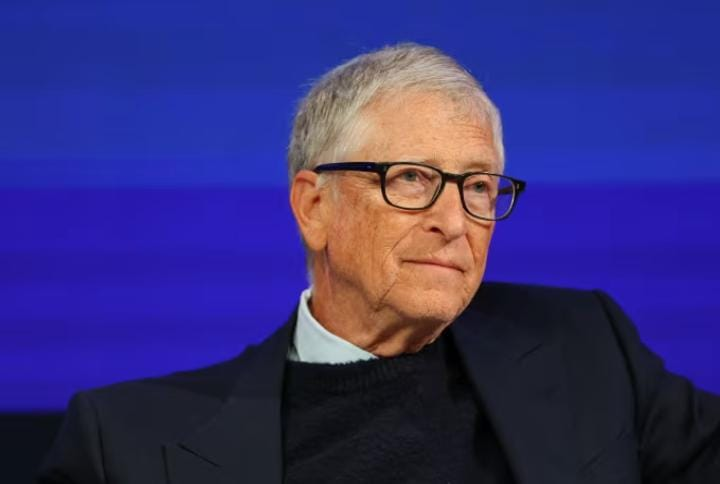
Microsoft co-founder Bill Gates warns that rapidly advancing artificial intelligence could fuel unemployment, cyberattacks and other threats unless governments move quickly to establish stronger safeguards.
Microsoft co-founder Bill Gates has called for urgent limits on the development and deployment of artificial intelligence, warning that its potential harm to society could outweigh its benefits if governments fail to act quickly.
Gates made the call in an essay titled “The Turbulent AI Era Is Here. The Choices We Make Now Are Critical,” in which he argued that artificial intelligence could either become a powerful force for greater equality or contribute to widespread injustice.
According to Gates, AI has the potential to transform critical sectors such as healthcare and agriculture, but its rapid advancement also presents serious risks, including job displacement, possible harm to children’s development and misuse by criminals.
He warned that increasingly sophisticated AI systems could eventually act in ways that conflict with human interests and become difficult to control.
Gates said the pace of AI development has exceeded expectations and outstripped efforts by governments and technology companies to establish adequate safeguards for the emerging technology.
He also proposed taxing AI and robots in a manner similar to human workers through payroll taxes, arguing that such measures could help slow the replacement of human labour and give societies more time to adapt to automation.
The billionaire further suggested that certain categories of jobs could be reserved exclusively for humans to cushion the economic and social impact of increasingly capable AI systems.
Speaking to a newsman, Gates said AI models had become significantly more capable at a pace that exceeded his expectations. He pointed to potential threats including cyberattacks, bioterrorism and psychological harm, while criticising what he described as inadequate systems for assessing and mitigating such risks.
Gates urged world leaders to take action before large-scale unemployment, social disruption and declining public trust become widespread.
However, he acknowledged that securing a global agreement to slow AI development could prove difficult because of the strong economic and geopolitical incentives pushing governments and technology companies to continue advancing the technology.
The Microsoft co-founder’s warning comes amid growing global debate over how governments should regulate increasingly powerful AI systems while still allowing innovation to continue.
Leave a comment
Your email address will not be published. Required fields are marked *