

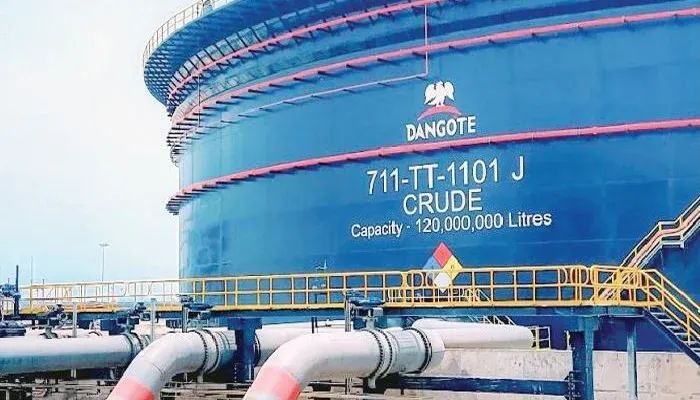
Federal High Court in Lagos orders petroleum regulator to halt any attempt to seal, restrict access to or interfere with operations at the 700,000-barrel-per-day refinery pending further hearing.
A Federal High Court in Lagos has issued an interim injunction restraining the Nigerian Midstream and Downstream Petroleum Regulatory Authority (NMDPRA) from shutting down, sealing or interfering with the operations of the Dangote Petroleum Refinery in the Lekki Free Zone.
Justice Akintayo Aluko granted the order on Monday while ruling on an ex parte application filed by Dangote Petroleum Refinery, following a move by the company to prevent the petroleum regulator from enforcing a directive that allegedly suspended the loading and truck-out of petroleum products from the refinery.
The suit, marked FHC/L/CS/1174/26, was filed and argued on behalf of Dangote Petroleum Refinery by a legal team led by Senior Advocate of Nigeria, Olawale Akoni.
The refinery had approached the court after the NMDPRA issued a letter dated August 24, 2026, which the company said purported to suspend the loading and evacuation of its petroleum products.
Dangote asked the court to restrain the regulator, its officials and agents from entering its facilities, sealing the refinery, shutting down its operations, restricting access or taking any other action that could interfere with its activities at the Lekki Free Zone pending the determination of the substantive application.
In granting the interim order, Justice Aluko said the court had carefully considered the 42-paragraph affidavit filed by the refinery, the documents attached to it and the legal submissions made by counsel.
The judge also drew attention to a letter written by the Attorney-General of the Federation on March 2, 2026.
According to Justice Aluko, the letter stated that the NMDPRA was not entitled to exercise regulatory or oversight functions over operations within free trade zones.
“I have also seen the letter issued by the Attorney-General of the Federation, dated March 2, 2026, which clearly stated that the defendant is not entitled to exercise regulatory powers or oversight functions over operations within the free zones,” the judge said.
Justice Aluko explained that courts have an inherent responsibility to preserve the subject matter of a dispute and prevent it from being destroyed, altered or rendered ineffective before the substantive case can be heard.
He said, having considered the circumstances surrounding the application, the conditions required for the granting of an interim injunction had been established.
The judge also noted that Dangote Petroleum Refinery had undertaken to indemnify the NMDPRA in damages should it later be determined that the interim order was wrongly granted.
Consequently, Justice Aluko granted the application in the terms sought by the refinery.
He directed the plaintiff to file a formal undertaking as to damages and ordered that the interim order, together with the court's notice, be served on the NMDPRA.
The ruling temporarily shields the Dangote refinery from any enforcement action contemplated in the NMDPRA's August 24 directive until the court considers the substantive motion.
The dispute places the regulatory authority of the NMDPRA over operations within free trade zones at the centre of the legal battle, with the court expected to examine the substantive issues at the next stage of proceedings.
The case has been adjourned until September 9, 2026, for the hearing of the motion on notice.
The Dangote refinery, located within the Lekki Free Zone in Lagos, is designed to process up to 700,000 barrels of crude oil per day and has become a major component of Nigeria's efforts to expand domestic refining capacity and reduce dependence on imported petroleum products.
The outcome of the ongoing legal proceedings could therefore have significant implications for the relationship between the refinery and petroleum regulators, particularly over the extent of regulatory oversight within free trade zones.
Leave a comment
Your email address will not be published. Required fields are marked *