

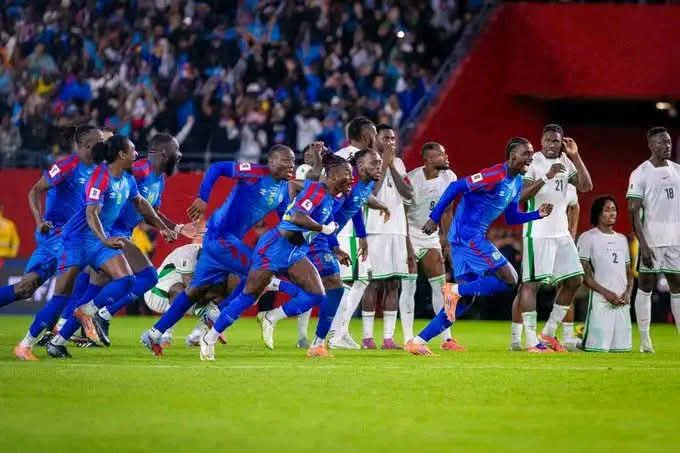
Investigation raises fresh questions overNigeria’s failed complaint after Congo eliminated the Super Eagles and later secured a place at the 2026 World Cup.
FIFA was aware that the Democratic Republic of Congo had fielded an allegedly ineligible player but nevertheless allowed the country to continue its World Cup qualification campaign, according to an investigation by The New York Times.
The revelation has reignited questions over FIFA’s handling of a complaint filed by the Nigeria Football Federation (NFF) after the Super Eagles were eliminated by Congo in the African World Cup play-off final in November 2025.
According to the Times, FIFA’s own legal officials privately concluded that Congo had breached player eligibility rules involving goalkeeper Lionel Mpasi, who had previously represented France at youth level.
Mpasi reportedly had not completed the required documentation to change his international affiliation before representing Congo.
Despite the internal finding, FIFA did not remove Congo from the qualification process or overturn the results of matches in which Mpasi played.
Congo subsequently defeated Jamaica in March to secure its first World Cup appearance in 52 years.
The development is particularly significant for Nigeria, whose hopes of reaching the 2026 tournament ended after Congo defeated the Super Eagles on penalties in the African play-off final.
Nigeria had already missed the 2022 World Cup in Qatar, meaning the defeat condemned the country to a second consecutive absence from football’s biggest tournament.
Nigeria had challenged Congo’s player eligibility
In December 2025, the NFF formally complained to FIFA, questioning the eligibility of several players used by Congo.
The Nigerian federation specifically raised concerns about foreign-born players, including Mpasi, and alleged that the Congolese football authorities had provided misleading information while securing their clearance to represent the country.
Documents and correspondence reviewed by The New York Times, together with information from a senior official directly involved in the matter, reportedly show that FIFA considered several possible responses.
Among the options were awarding Nigeria the match, imposing financial sanctions on Congo, replacing Congo with Nigeria in the subsequent play-off against Jamaica, or taking no action on the grounds that Nigeria’s complaint had been submitted too late.
Under FIFA regulations, fielding an ineligible player can lead to a team forfeiting the match in which the player participated.
FIFA has previously imposed such sanctions.
In 2016, the governing body sanctioned Greece after the country fielded an ineligible player who had previously represented Australia at youth level, awarding Turkey a 3-0 victory.
Two years later, FIFA changed the results of two Bolivia World Cup qualifying matches after determining that Bolivia had fielded a player who had previously represented Paraguay.
Those precedents have added to questions surrounding FIFA’s decision-making in the Congo case.
Former NFF president questions FIFA’s response
Former NFF president Ibrahim Musa Gusau told The New York Times that he was informed Nigeria’s complaint had been rejected on technical grounds.
However, he said he was not told that FIFA officials had themselves identified a problem with Mpasi’s eligibility.
“They just kept quiet,” Gusau said, according to the newspaper, arguing that the matter warranted further investigation.
The Times said it also reviewed a document that corresponded with Gusau’s description of FIFA’s response to the Nigerian complaint.
The findings could intensify scrutiny of why Nigeria was not informed about the concerns surrounding Mpasi and why Congo was permitted to continue its qualification campaign.
Questions over FIFA’s African football relationships
The case has also drawn attention to FIFA President Gianni Infantino’s relationship with senior African football officials.
At the time FIFA was examining the Congo eligibility dispute, Véron Mosengo-Omba, described in the report as an Infantino ally, was preparing to contest the presidency of the Congolese football federation.
Two months after Congo qualified for the World Cup, Mosengo-Omba emerged as the sole candidate and was elected president after eight other contenders had either withdrawn or been disqualified following changes to the federation’s eligibility rules.
Cameroonian former FIFA official Prince Zelkifli Rahman Ngoufonja, popularly known as Prince Zul, told The New York Times that the relationship between Infantino and Mosengo-Omba raised questions about what Congo’s removal from the World Cup could have meant for the election.
“If FIFA removed Congo from the World Cup,” he said, Mosengo-Omba’s prospects “could have been damaged.”
Mosengo-Omba, however, told the newspaper that he was unaware of FIFA’s findings concerning Mpasi’s eligibility.
There is no indication in the report that he was involved in FIFA’s handling of Nigeria’s complaint.
Jamaica and CONCACAF react
Jamaica, the team Congo defeated to secure its World Cup place, did not respond to requests for comment, according to The New York Times.
CONCACAF, the governing body for football in North America, Central America and the Caribbean, expressed concern over the broader issue of how eligibility complaints are handled.
“Any concerns regarding player eligibility, particularly those that may affect the integrity of a competition or the interests of one of our member associations, need to be thoroughly reviewed and addressed,” the organisation said.
The comments underscore the wider implications of the dispute, which goes beyond Nigeria and Congo and touches on the credibility of FIFA’s eligibility and disciplinary procedures.
Nigeria’s World Cup hopes remain at the centre of the controversy
For Nigeria, the issue carries particular weight.
The Super Eagles had reached the African play-off final with a place at the 2026 World Cup at stake, only to lose to Congo on penalties. Nigeria subsequently filed its complaint, challenging the eligibility of players used by its opponents.
Had FIFA ruled that Congo had fielded an ineligible player and imposed a sporting sanction, the consequences could have been significant for the qualification process.
Instead, Congo remained in contention, defeated Jamaica and secured a place at the World Cup.
The latest revelations therefore raise a central question: if FIFA’s legal officials had already identified an eligibility problem involving a player who appeared for Congo, why was the team allowed to continue its qualification campaign?
The New York Times investigation places that question at the heart of renewed scrutiny of FIFA’s handling of Nigeria’s complaint and its broader approach to player eligibility.
The controversy also comes amid other questions about FIFA’s handling of disciplinary and political matters surrounding the 2026 World Cup, including scrutiny over the governing body’s decision to lift the suspension of United States forward Folarin Balogun following a reported phone call between Infantino and U.S. President Donald Trump.
Leave a comment
Your email address will not be published. Required fields are marked *