

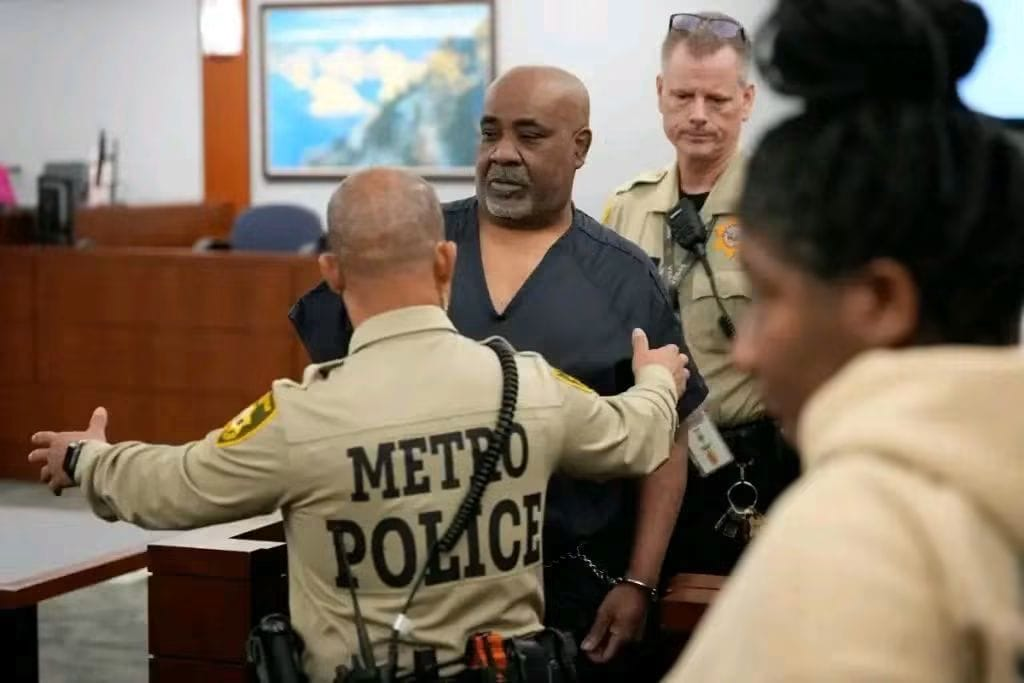
Former gang leader convicted of orchestrating the 1996 killing of the legendary rapper in Las Vegas, bringing a major breakthrough in one of America’s most notorious unsolved murder cases.
Former American gang leader Duane “Keffe D” Davis has been sentenced to 40 years in prison for his role in orchestrating the murder of legendary rapper Tupac Shakur, nearly three decades after the hip-hop icon was gunned down in Las Vegas.
The sentencing marks a major development in a case that has remained one of the most closely watched unsolved killings in American music history.
According to the report, Davis, 63, was convicted in September of one count of murder with a deadly weapon over the fatal drive-by shooting that claimed Shakur’s life on September 7, 1996.
Although Davis was accused of organising the attack, prosecutors maintained that he did not pull the trigger himself. He has indicated that he intends to appeal the verdict.
How prosecutors linked Davis to Tupac’s killing
During the trial, prosecutors alleged that Davis, a former leader of the South Side Compton Crips street gang, played a central role in planning the shooting and supplying the firearm used in the attack.
They identified his nephew, Orlando Anderson, as the person who allegedly opened fire on Shakur from a white Cadillac.
Anderson denied involvement in the killing before his death in an unrelated shooting in 1998.
Investigators struggled for years to secure a conviction, as conflicting accounts and unanswered questions surrounding the shooting continued to cloud the case.
Davis’ own statements eventually became central to the prosecution’s efforts to establish his connection to the crime.
Davis’ past statements became key evidence
Davis had repeatedly acknowledged that he was inside the white Cadillac from which the shots were fired.
In a secret police interview in 2008, conducted in connection with the investigation into the murder of fellow rap star Christopher Wallace, popularly known as The Notorious B.I.G., Davis disclosed information about his alleged involvement in Shakur’s killing.
The interview was reportedly conducted under an agreement intended to protect him from prosecution.
However, Davis later discussed the killing in his 2019 memoir, Compton Street Legend, and in subsequent media interviews. Those disclosures undermined the protection he had expected and enabled prosecutors to use the earlier police interview as evidence at trial.
His defence team challenged the prosecution’s account, arguing that Davis had fabricated or exaggerated aspects of his story to sell books, attract publicity and profit from his alleged association with the high-profile murder.
Despite those arguments, a jury found him guilty.
Tupac’s murder haunted hip-hop for nearly 30 years
Shakur was just 25 when he was shot in Las Vegas on September 7, 1996, while riding in a car after attending a boxing match.
The rapper died from his injuries six days later, on September 13, 1996.
Known for his powerful lyrics, outspoken views and influence on American hip-hop, Shakur became one of the most celebrated figures in music. His recordings have sold more than 75 million copies worldwide, cementing his legacy long after his death.
His murder generated decades of speculation, competing theories and renewed investigations, with the lack of a conviction frustrating fans and keeping the case in the public spotlight.
The killing of The Notorious B.I.G. in March 1997 further intensified attention on the violence surrounding the American rap scene during the 1990s.
A major breakthrough in a decades-old case
Davis’ conviction represents the first in the long-running investigation into Shakur’s murder and a significant milestone in a case that remained unresolved for almost three decades.
His sentencing brings a measure of legal accountability in the killing of one of hip-hop’s most influential artists, although his planned appeal means the legal battle may not yet be over.
For generations of fans, Shakur’s death has remained a painful reminder of a promising career cut short. The 40-year prison sentence marks a major turning point in the pursuit of justice for the rapper, whose music and cultural influence continue to endure.
Leave a comment
Your email address will not be published. Required fields are marked *