

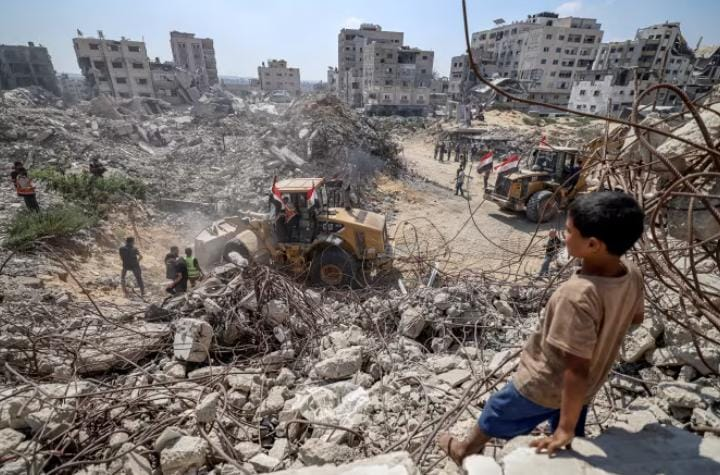
Families remain trapped between hope and grief as damaged infrastructure, limited recovery equipment, restricted access and a lack of DNA testing leave thousands of Palestinians unaccounted for.
Thousands of Palestinian families are still searching for missing relatives in Gaza, where destroyed buildings, restricted access to affected areas and shortages of recovery equipment are hampering efforts to locate and identify the dead.
Gaza’s Civil Defense estimates that about 8,000 people remain missing, many believed to be buried beneath rubble left by Israel’s military offensive.
The International Committee of the Red Cross has warned that delays are causing crucial evidence to disappear, making the identification and recovery of remains increasingly difficult.
For Mohammad Yousef Shalayel, the search is deeply personal.
An Israeli strike on his family’s home in Jabalya, northern Gaza, on November 1, 2024, killed or buried relatives including his elderly mother, siblings and their children.
He said he found scattered human remains the following morning but has been unable to return to the site because Israeli forces control large parts of the devastated territory. Nearly two years later, many of his relatives remain unaccounted for, leaving him without the certainty or burial rites he longs for.
Access restrictions around the Israeli military’s designated yellow line have further complicated recovery operations, residents and aid workers.
Palestinians say demolitions and rubble-clearing operations in areas under Israeli control risk destroying burial sites and evidence.
UN human rights chief Volker Türk has called for the preservation of evidence and access for international investigators. Israel has said it will withhold heavy machinery and reconstruction materials until Hamas disarms, while Palestinian officials say the shortage of excavators, bulldozers and trucks is slowing recovery efforts even in accessible areas.
Gaza’s Civil Defense says its teams have recovered around 1,000 bodies from rubble since October, but operations remain constrained by limited equipment and the danger posed by unexploded ordnance.
The International Committee of the Red Cross says recovery workers sometimes have to remove debris a few centimetres at a time. Identification is another major obstacle: Gaza has few remaining specialist forensic doctors, no accessible DNA testing facilities, and hospitals face shortages of electricity, fuel and refrigerated storage.
As a result, many bodies are buried without names, leaving families unable to establish with certainty what happened to their loved ones.
The uncertainty is taking a severe emotional toll. Suha al-Sharif, 55, told CNN she has been unable to locate the body of her son, Jihad, who she said was shot and killed in November 2023.
Aid workers describe families experiencing ambiguous loss a painful state in which people cannot fully mourn because they do not know whether or where their relatives’ remains have been recovered.
In Deir al-Balah, around 1,000 unidentified people have been buried in what residents call the cemetery of the missing, with serial numbers assigned to graves in the hope that future DNA testing may allow identification.
Under international humanitarian law, parties to an armed conflict have obligations concerning the search for and recovery of the dead, as well as the collection and preservation of information about missing people. Yet Gaza’s continuing insecurity, access restrictions and damaged medical infrastructure have left families waiting without answers.
For Shalayel and thousands of others, finding theirrelatives is about more than recovering remains: it is about dignity, closure and the chance to give the dead a known and respectful burial.
Leave a comment
Your email address will not be published. Required fields are marked *