

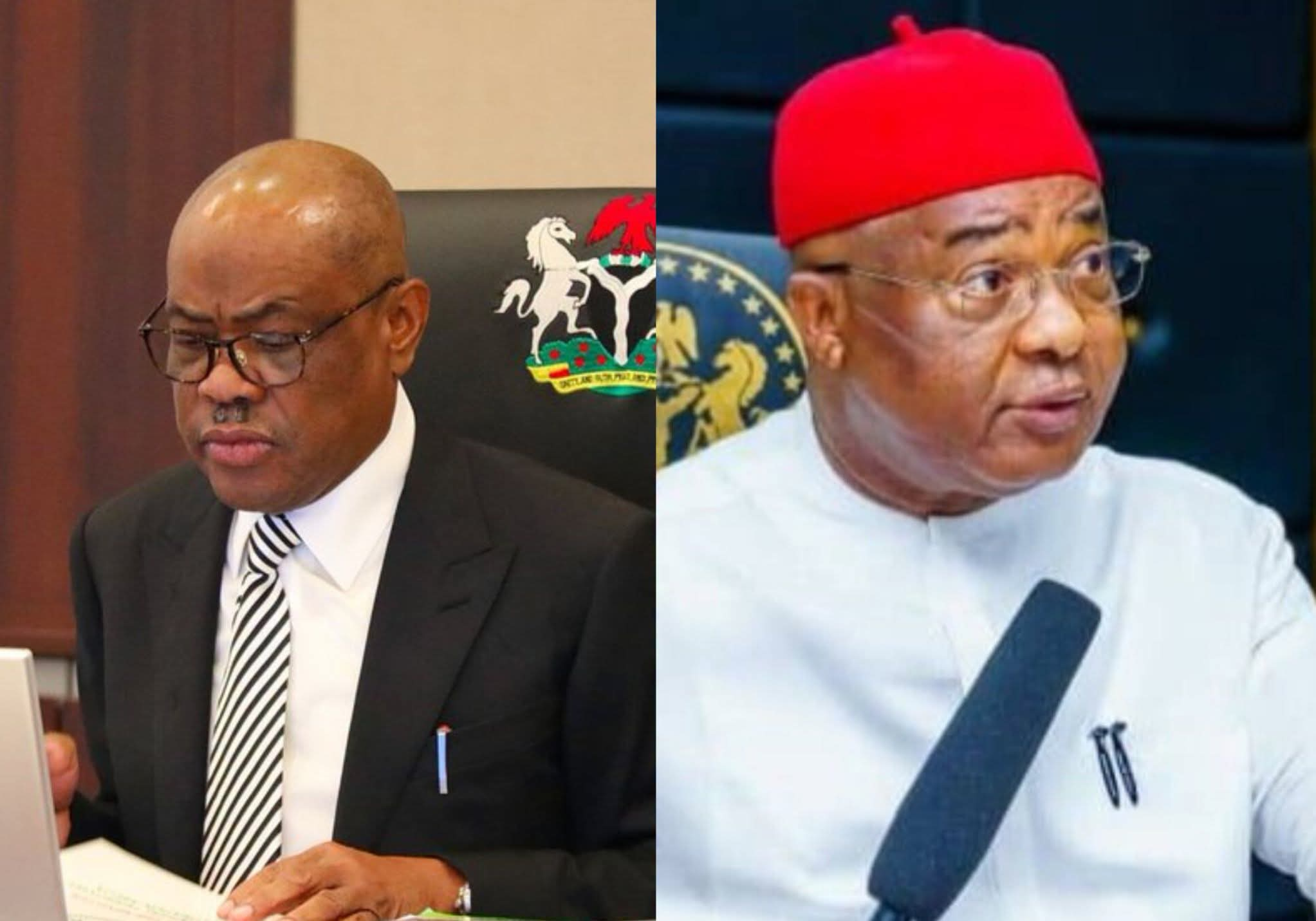
FCT Minister Nyesom Wike says his support for President Bola Tinubu does not prevent opposition parties from fielding candidates, insisting APC governors should not use the President as an excuse to oppose his political activities.
Federal Capital Territory (FCT) Minister Nyesom Wike has described governors elected on the platform of the All Progressives Congress (APC) as “politically lazy” following their rejection of his proposed Rainbow Coalition ahead of the 2027 general elections.
Wike made the remarks during an interview on Arise TV’s Prime Time on Tuesday, while responding to the position of the APC Governors’ Forum, which has distanced itself from his coalition initiative.
The APC governors, led by their chairman and Imo State Governor, Hope Uzodimma, recently declared that they would neither participate in, support nor endorse any alliance capable of undermining President Bola Tinubu’s re-election bid or weakening APC candidates contesting elections at various levels.
The governors’ position was widely seen as a response to political realignments involving opposition figures and other politicians ahead of the 2027 elections.
Wike, however, rejected the argument that his activities posed a threat to the APC or President Tinubu.
“They are politically lazy. When you have your local problems, don’t use Mr President as your excuse,” the minister said.
ALSO READ- 2027: APC Governors Reject Wike’s Rainbow Coalition, Back Only Party Candidates
https://dailyobserver.ng/2027-apc-governors-reject-wikes-rainbow-coalition-back-only-party-candidates
He argued that his decision to support Tinubu should not be interpreted as an attempt to prevent political parties from presenting candidates for legislative, governorship or other elective positions.
Wike maintained that his support for the President was based on his personal political conviction and was separate from his relationship with the Peoples Democratic Party (PDP), where he remains a prominent figure despite his disagreements with some members of the party.
“I have said I will support the President and I am still supporting him. What has that got to do with my party?” he asked.
The former Rivers State governor cited governors belonging to different political parties as examples, arguing that supporting a presidential candidate does not necessarily mean abandoning a political party’s candidates at other levels.
“Take Soludo, Adeleke and Otti. Does it mean that their parties will not present other candidates? This thing they are saying does not have any basis,” Wike said.
He was referring to Anambra State Governor Chukwuma Soludo, Osun State Governor Ademola Adeleke and Abia State Governor Alex Otti, who belong to different political platforms.
Wike also insisted that opposition to his political activities did not begin with his decision to support Tinubu.
According to him, he faced resistance from political actors during his tenure as Rivers State governor and later after his appointment as FCT minister.
“This thing did not start today. It started at ministerial position. They were not happy that I was Minister of FCT. Also, they were unhappy when I was governor,” he said.
The minister suggested that some of his critics might not have access to all the information available to him and warned against drawing conclusions without understanding the broader political circumstances.
“If they know what I know, they would not come out to shout,” he added.
Wike further explained the reasoning behind his decision to support Tinubu during the 2023 presidential election.
He said his position was influenced by his belief that, after the eight-year administration of former President Muhammadu Buhari from 2015 to 2023, the presidency should return to the southern part of the country.
“Recall that in 2023, as far as the President is concerned, it is my belief that it was the time of the South and so it would be unfair that it goes back to the North,” Wike said.
His latest comments come as political parties, governors and prominent politicians intensify consultations and realignments ahead of the 2027 general elections.
The disagreement over the Rainbow Coalition also highlights the growing tension surrounding efforts to build broader political alliances outside existing party structures, particularly as politicians assess their positions ahead of the next presidential and other elections.
Leave a comment
Your email address will not be published. Required fields are marked *