

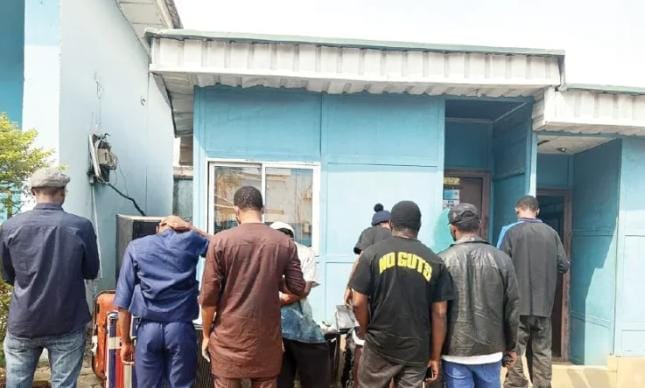
Victims lured with fake overseas jobs allegedly end up in guarded compounds in Laos and Myanmar, where they are forced to carry out online scams under threats of violence.
Nigerian youths searching for better opportunities abroad are increasingly being lured through social media and fraudulent job offers into cybercrime compounds in Southeast Asia, where some victims say they were held against their will and forced to defraud people online.
Investigations into the trafficking network have uncovered accounts of Nigerians who were promised legitimate employment but allegedly ended up in heavily guarded compounds in Laos and Myanmar, where they were forced to participate in cyber-enabled fraud.
One of the victims, 26-year-old Sabiu from Borno State, said he travelled to Lagos after a Chinese businessman offered him a three-month telecommunications job.
Instead of the promised employment, Sabiu said he was taken to the Golden Triangle Special Economic Zone in Bokeo Province, Laos, where he discovered that the operation was involved in online fraud.
According to him, his passport was confiscated and he was forced to sign a two-year contract written in Chinese before being made to work for as many as 17 hours a day.
Sabiu said workers were trained to impersonate women online, establish romantic relationships with unsuspecting victims and eventually persuade them to invest in fraudulent cryptocurrency platforms.
He alleged that workers who failed to meet daily targets were punished by guards, with some allegedly beaten or subjected to electric shocks.
When he demanded to leave, Sabiu said his boss told him, “I paid $5,000 for you,” implying that money had been paid to acquire his services.
He said he was subsequently assaulted, had $9,000 drained from his cryptocurrency wallet and was eventually abandoned near the Mekong River.
Sabiu spent about six months homeless before receiving assistance from the International Organization for Migration, the Nigerian Embassy in Vietnam, the National Agency for the Prohibition of Trafficking in Persons and the National Intelligence Agency.
He eventually returned to Nigeria in September 2025 with no money and more than ₦3 million in debt.
Another victim allegedly trafficked to Myanmar
Another Nigerian, Offor, from Abia State, said he was recruited through a Facebook advertisement promising a monthly salary of $1,500 for an online marketing job in Thailand.
After arriving in Bangkok in September 2025, Offor said armed men transported him through several locations before taking him across the border into Myanmar.
He alleged that he was held in a guarded compound alongside hundreds of other foreign nationals and forced to participate in online fraud.
The experiences of Sabiu and Offor reflect a broader trafficking pattern in which criminal networks exploit the desperation of young people seeking employment abroad.
Recruiters often use social media platforms to advertise seemingly attractive jobs in countries such as Thailand, Laos, Myanmar and other parts of Southeast Asia. Victims may be promised jobs in telecommunications, online marketing, customer service, cryptocurrency or other technology-related sectors.
NAPTIP has warned that the networks are increasingly targeting educated and technologically skilled Nigerians, particularly young people who may be attracted by the prospect of earning significantly higher salaries overseas.
In February 2026, NAPTIP said it repatriated 23 Nigerian youths from Thailand after they were trafficked for cyber-enabled crimes.
The agency also recorded 93 convictions and more than 2,500 interceptions of potential trafficking victims in 2025, highlighting the scale of the threat.
Authorities and anti-trafficking organisations have repeatedly urged Nigerians to exercise caution when responding to overseas employment offers, particularly those received through social media.
Potential migrants are advised to independently verify recruiters and employers, obtain proper employment documentation and confirm visa and travel arrangements before leaving Nigeria.
Experts also warn that unusually high salaries, vague job descriptions, pressure to travel quickly, demands for secrecy and offers in which recruiters handle all travel arrangements without providing verifiable employment documents should be treated as major warning signs.
For victims already trapped in trafficking compounds, escaping can be extremely difficult because criminal groups may confiscate passports, restrict movement, impose financial penalties and use threats or violence to prevent victims from seeking help.
The cases of Sabiu and Offor underscore the human cost behind the growing cybercrime economy in Southeast Asia—and the risks faced by Nigerians who accept seemingly lucrative overseas employment opportunities without independently verifying the people and companies behind them.
Leave a comment
Your email address will not be published. Required fields are marked *