

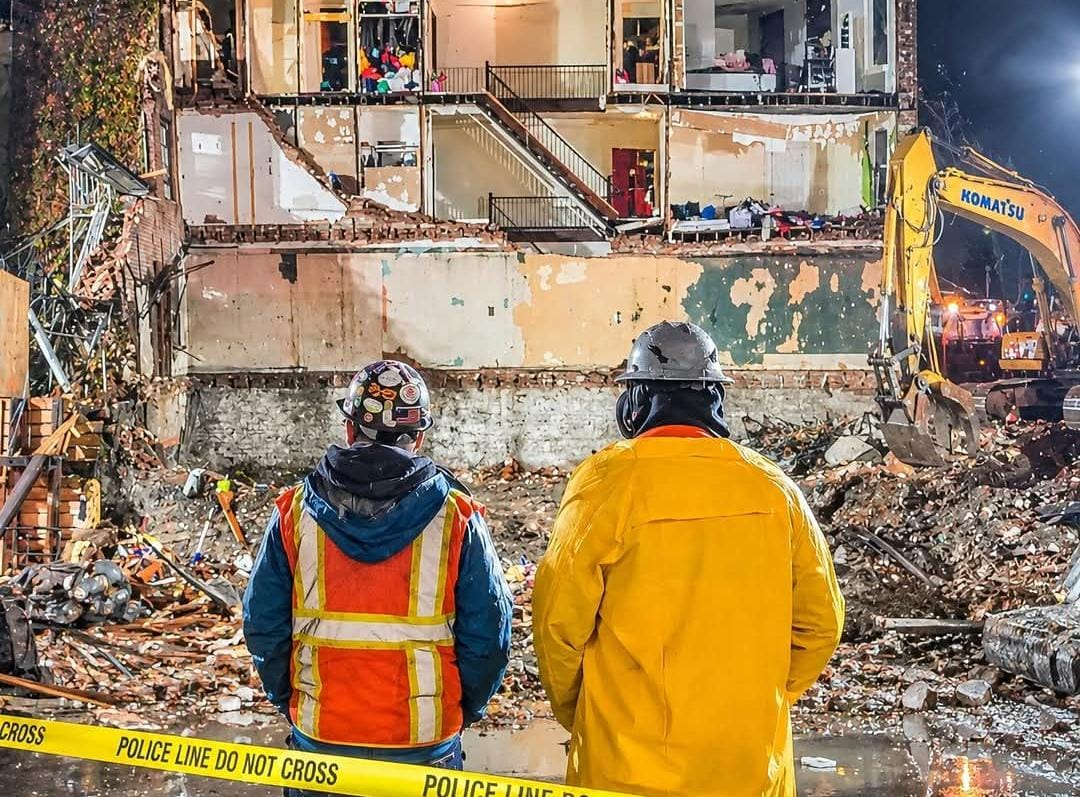
Olufemi Falade, owner of the collapsed Brooklyn property, reportedly owes hundreds of thousands of dollars in unpaid taxes, water bills and regulatory fines, while records reveal nearly 100 unresolved housing violations before the tragedy.
A Nigerian property owner whose building collapsed in Brooklyn, New York, killing eight people, is facing renewed scrutiny over his history of housing violations, unpaid debts and alleged failure to address longstanding safety concerns.
The landlord, identified as Olufemi Falade, reportedly owes more than $450,000 in outstanding property taxes, water bills, regulatory fines and other financial obligations, according to an investigation by The New York Post.
Falade owns the three-storey building located at 1321 Flatbush Avenue, which became the scene of the deadly disaster. His record with New York housing authorities has now raised serious questions about how the property remained in operation despite years of unresolved complaints and violations.
According to the newspaper, Falade has appeared on the New York City Public Advocate's annual Worst Landlords Watchlist six times, highlighting his longstanding history of disputes with housing regulators.
A review of municipal records reportedly showed that approximately $170,000 of his outstanding liabilities came from fines imposed by the Department of Buildings in 2019 over improperly displayed signs.
He also owes $114,945 in unpaid water bills and another $113,526 in property taxes dating back to 2021.
His reported financial liabilities extend beyond municipal obligations. Records indicate that Falade was hit with a federal tax lien in 2010 over $49,269 in unpaid personal income taxes owed to the Internal Revenue Service.
He also reportedly owes New York State $4,316 in personal income taxes.
However, the financial liabilities are only part of the growing controversy surrounding the building collapse, as questions have emerged over construction approvals, structural support and the enforcement of safety regulations.
Questions Over Construction Approval
An earlier report by The New York Post revealed that New York City's Department of Buildings approved excavation plans for an adjoining development at 2625 Bedford Avenue in March, despite concerns about whether the proposed construction had sufficient structural support.
The developer planned to construct a three-storey, 25,000-square-foot mixed-use building on the neighbouring property.
Although the approved plans reportedly included extensive shoring and bracing arrangements across much of the construction site, including the backyard of Falade's property, they allegedly failed to provide adequate structural reinforcement immediately alongside the building that later collapsed.
The circumstances surrounding the excavation and its possible connection to the collapse remain important areas of investigation.
Collapsed Building Had 98 Outstanding Violations
Records from the New York City Department of Housing Preservation and Development reportedly showed that the collapsed property had 98 outstanding housing violations before the disaster.
The documented problems included a leaking roof, defective doors, bedbug infestations and exposed electrical wiring.
Some complaints about the property's leaking roof reportedly dated as far back as 1976, while other violations were recorded as recently as earlier this year.
The building was approximately 96 years old when it collapsed.
Falade acquired the property in 1999 through a company known as Femi Realty Corp. The purchase price was not disclosed.
In November 2024, ownership was transferred to another company under his control, Isolag Realty Corp.
Interestingly, property records reportedly showed that Falade signed the transaction documents on behalf of both companies, effectively representing the seller and buyer in the same transaction. No money reportedly changed hands.
The arrangement has attracted attention amid questions about whether transferring properties between companies controlled by the same individual could complicate efforts to enforce outstanding financial and regulatory obligations.
However, such transactions do not automatically cancel existing debts or remove legal responsibilities attached to a property.
Landlord Previously Jailed Over Housing Violations
Falade's reported history of housing violations dates back several decades.
In 2006, he was sentenced to 12 days in jail and ordered to pay an additional $50,000 in civil contempt penalties after failing to address more than 1,800 housing violations recorded across 12 Brooklyn properties he owned at the time.
The violations reportedly included serious living conditions such as vermin infestations, exposed electrical wiring and leaking pipes.
His previous punishment has now raised questions about the effectiveness of New York City's enforcement system, particularly in dealing with landlords repeatedly accused of neglecting their properties.
Massimo D'Angelo, a veteran real estate attorney with Blank Rome, called for stronger cooperation between the city's housing and building regulatory agencies.
He argued that the Department of Housing Preservation and Development and the Department of Buildings needed to work more closely, particularly when dealing with properties facing serious structural and safety concerns.
D'Angelo also questioned why previous enforcement measures had failed to produce lasting improvements, pointing to Falade's earlier jail sentence as an indication of weaknesses in the city's approach to repeat offenders.
He maintained that regulatory authorities needed to respond more effectively and promptly to landlords who repeatedly failed to address violations.
As investigations into the collapse continue, Falade has reportedly not responded to requests for comments concerning his outstanding debts, housing violations and the circumstances surrounding the tragedy.
The disaster has intensified scrutiny of New York City's housing enforcement system, with growing questions about how a building with decades of reported complaints and 98 outstanding violations could remain occupied before the fatal incident.
For the families of the eight victims, the central concern remains whether the tragedy could have been prevented if longstanding safety complaints had been properly addressed.
Leave a comment
Your email address will not be published. Required fields are marked *