

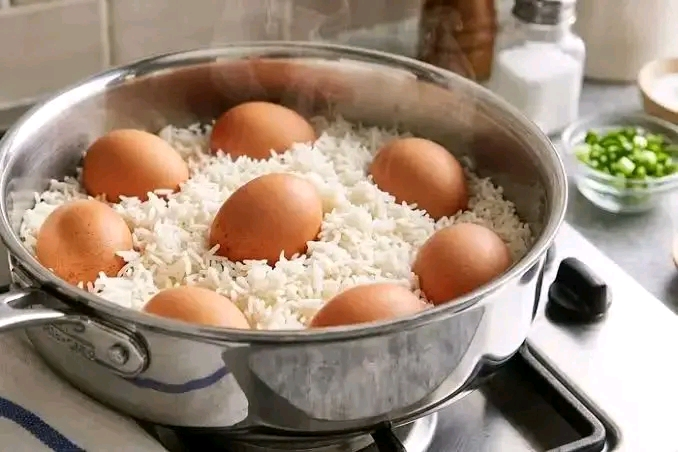
Experts say eggshells may carry bacteria such as Salmonella and E. coli that can contaminate rice during cooking, urging households to prepare the two foods separately.
Registered dietitian-nutritionists have warned Nigerians against the common practice of boiling unwashed eggs together with rice in the same pot, saying it could increase the risk of cross-contamination and foodborne infections.
The experts said eggshells can carry harmful bacteria, including Salmonella and E. coli, which may be transferred to rice during the cooking process.
The warning comes amid renewed discussions on social media over the practice, with some Nigerians saying they cook eggs and rice together to save cooking gas, water, time and utensils, particularly as the cost of household energy continues to rise.
However, the nutritionists stressed that the potential health consequences of foodborne infections could outweigh the financial savings.
How contamination can occur
James Oloyede, a registered dietitian-nutritionist and former Director of Nutrition Services and Health Education at the Osun State Primary Health Care Development Board, described cooking eggs and rice together as a potential risk factor for cross-contamination.
He explained that bacteria present on an eggshell could come into contact with the water used to cook the rice.
“Cooking egg and rice together in the same pot has been found to be a risk factor in cross-contamination of certain bacteria, especially Salmonella, that can be found on the shell of the egg even after washing with the rice that is being cooked,” Oloyede said.
According to him, rice begins absorbing water almost immediately after it is placed in the cooking pot. This means that if contaminated water surrounds an egg carrying bacteria, the microorganisms could potentially come into contact with the rice.
“The challenge with rice is that absorption begins to take place the moment you put your rice in the water. When the water begins to warm up, we see the rice grain begin to swell. What makes it swell is the absorption of the water,” he explained.
“And if the egg contains Salmonella bacteria, the tendency is that when the rice is absorbing water, then the bacteria can also be absorbed together with the water and can remain throughout the process of the boiling.”
Oloyede also raised concerns about eggshells cracking during cooking. He said a cracked shell could allow egg white to spill into the rice, potentially affecting its appearance, taste and odour.
Some households reportedly place eggs inside nylon before putting them into the pot in an attempt to prevent direct contact with the rice. Oloyede, however, maintained that preparing the foods separately remains the safer approach.
“So it is important that, in a way to ensure food safety, we do not boil eggs together with rice in the same pot,” he said.
“But of course, the safest way of cooking egg and rice is to boil them separately. That’s the safest way.”
‘Savings may not be worth the health risk’
The nutritionist further cautioned that the consequences of a foodborne infection could extend beyond temporary discomfort.
He noted that illness could result in medical expenses, missed work and reduced productivity, potentially wiping out whatever money or cooking resources were saved by preparing the foods together.
Charles Oguikpe, another registered dietitian-nutritionist, also advised Nigerians to avoid the practice.
Oguikpe explained that contaminants from poultry droppings can remain on eggshells and may be transferred to food during cooking.
“The reason why we consider boiling eggs in the same pot while cooking rice on a sieve is that some contaminants in eggshells can cause harm to the human body because these contaminants will be dropped off on the rice,” he said.
“Contaminants like Salmonella or E. coli can drop off on the rice. That’s what we call cross-contamination.”
He said exposure to harmful bacteria could result in symptoms such as stomach cramps, diarrhoea and fever, while serious foodborne infections can lead to more severe complications.
“These contaminants are from poultry droppings from the chickens that lay these eggs. No matter how you wash it, you might not be very sure 100 per cent that it has gone off,” Oguikpe said.
He therefore advised households to cook the eggs and rice separately and remove the eggshells before serving.
Experts recommend separate cooking
Both nutritionists agreed that the simplest way to reduce the possibility of cross-contamination is to prepare the foods separately.
While the practice may appear convenient and economical, particularly for households trying to reduce cooking costs, the experts urged Nigerians to put food safety ahead of convenience.
They advised consumers to handle eggs carefully, keep raw eggs away from ready-to-eat foods and ensure that eggs and rice are properly cooked before consumption.
Leave a comment
Your email address will not be published. Required fields are marked *