

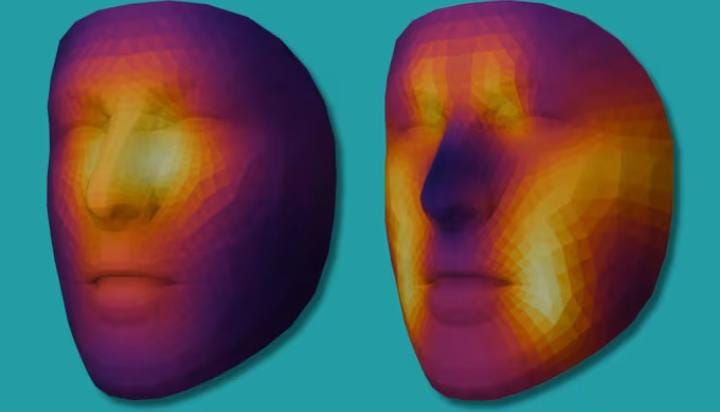
Researchers say facial analysis could help doctors assess biological age and short-term mortality risk, but independent experts warn the technology needs further clinical testing before it can be used in patient care.
According to a new study by researchers at Mass General Brigham in Boston, United States, a single facial photograph could help estimate a cancer patient’s biological age and likelihood of short-term survival.
The research suggests artificial intelligence could one day provide doctors with additional information when assessing patients’ health and planning treatment.
The researchers developed AI models using a foundation system trained on more than 40 million facial images.
One model, FAHR-FaceAge, estimates biological age based on facial features, while another, FAHR-FaceSurvival, combines facial analysis with clinical information to assess cancer patients’ survival risk.
Biological age refers to how a person’s body appears to have aged, rather than the number of years they have lived.
The findings showed a marked difference in short-term outcomes between patients classified as high and low risk.
Among 122 cancer patients identified by the survival model as being at high risk, 52.5 per cent died within 90 days of assessment.
By comparison, about 2 per cent of the 975 patients in the lowest-risk group died during the same period.
The age-estimation model also found that 21 per cent of 1,060 patients whose estimated biological age was more than 20 years above their actual age died within 90 days, compared with about 6 per cent of 4,195 patients whose estimated biological age was at least 10 years younger than their chronological age.
Study author Dr Raymond Mak, a radiation oncologist at Mass General Brigham Cancer Institute, said he was surprised that facial photographs could reveal patterns associated with mortality risk.
The models examined different facial regions when estimating age and survival, with researchers noting similarities between some of the features and descriptions of serious illness recorded by the ancient Greek physician Hippocrates.
The team also reported that cosmetic changes, including makeup, Botox injections, and facial surgery, did not affect the models’ performance in their tests.
However, independent experts cautioned that the findings do not mean a selfie can reliably determine an individual’s lifespan or replace a medical assessment. Wilbur Lam, a professor at Emory University who was not involved in the study, said the results were compelling but required prospective clinical validation. Miroslaw Bober of the University of Surrey similarly warned that estimating age from facial appearance does not directly measure biological ageing, adding that researchers must establish whether the technology offers useful information beyond doctors’ existing assessments.
The researchers said the models are intended to complement, not replace, conventional medical evaluations.
Further testing across hospitals, age groups, skin tones, and other patient populations will be necessary before the technology can be considered for routine clinical use.
Although the findings raise the possibility of using facial analysis to identify patients who may need closer evaluation, experts say its real-world value remains to be established.
Leave a comment
Your email address will not be published. Required fields are marked *