

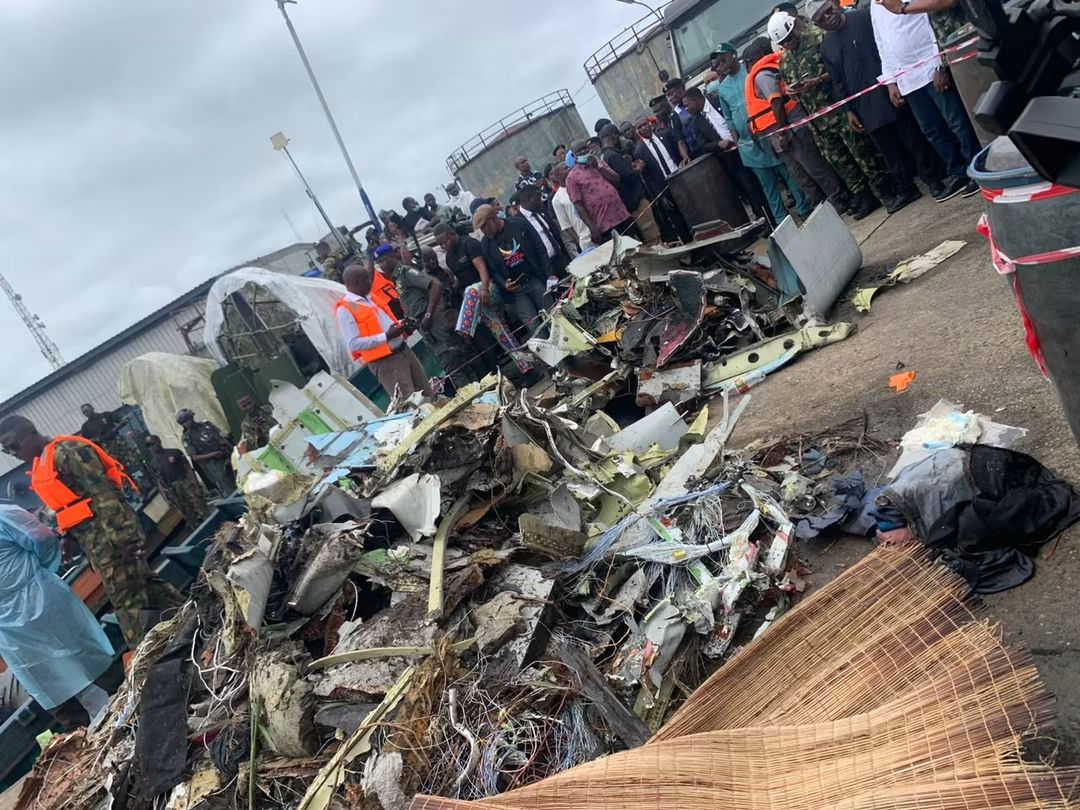
Search teams have recovered human remains, clothing and fragments of the aircraft, but the main body of the Nigerian Air Force ATR-42 remains submerged in the Igbokoda swamp.
The search for the wreckage and victims of the Nigerian Air Force aircraft that crashed in Igbokoda, Ondo State, has entered a difficult phase, with divers yet to locate the main body of the aircraft more than two days after the tragedy.
Ondo State Governor Lucky Aiyedatiwa, who visited the crash site on Wednesday, said search teams had recovered human remains, clothing and jackets believed to belong to personnel aboard the aircraft, alongside pieces of the damaged plane.
However, the main fuselage remained missing and was believed to have sunk deep into the swamp.
The ATR-42 aircraft, which was carrying 26 Nigerian Air Force personnel on a special mission from Benin to Lagos, crashed in Igbokoda, headquarters of Ilaje Local Government Area, on Monday morning.
According to the governor, no survivor had been found.
Aiyedatiwa visited the site with Nigerian Navy and Air Force personnel, divers, officials of the National Emergency Management Agency (NEMA), the State Emergency Management Agency and local residents who have been involved in the search operation.
He said the difficult terrain had significantly hampered the recovery operation, prompting the state government to deploy two amphibious machines, popularly known as swamp buggies, to improve access to the crash site.
The machines have enabled larger boats to move closer to the area while also helping search teams excavate sections of the swamp in an attempt to locate the submerged aircraft.
Aircraft may be buried deep in swamp
The governor said the nature of the terrain could explain why the aircraft had not been located.
He noted that the swamp was extremely deep, with some areas reaching about 30 metres before solid ground could be reached.
“From construction experience and analysis of this area, for you to get to refusal level, it’ll get to about 30 metres deep,” Aiyedatiwa told journalists.
He said the aircraft could therefore have plunged deep into the mud after crashing.
Meanwhile, Nigerian Navy personnel and local divers continued searching deeper sections of the swamp for the cockpit, additional wreckage and the remains of those on board.
The governor said aviation fuel was also leaking into the water, raising concerns about pollution around the crash site.
Pilot may have steered plane away from community
Aiyedatiwa said accounts from residents who witnessed the crash suggested that the aircraft appeared to be experiencing serious engine trouble shortly before it went down.
According to him, the aircraft was initially heading towards the community but appeared to have been manoeuvred away before crashing roughly 200 metres from the populated area.
Residents reportedly heard an unusual sound from the aircraft before it descended rapidly.
The governor said the pilot's actions may have prevented an even greater disaster because the aircraft could have crashed directly into the community.
“Only the pilot could have explained the effort made to manoeuvre the aircraft away from the community,” he said.
He added that, given the condition of the crash site and the remains recovered so far, hopes of finding survivors were extremely slim.
Aiyedatiwa expressed sympathy to the families of the victims and the Nigerian Air Force, describing those on board as young and capable Nigerians who had committed themselves to defending the country.
He urged the recovery teams to intensify their efforts to retrieve the remaining wreckage and the bodies of the victims.
Navy deploys sonar technology
The recovery operation received additional technical support on Wednesday as the Flag Officer Commanding, Western Naval Command, Rear Admiral Abubakar Mustapha, and the Air Officer Commanding, Logistics Command, Nigerian Air Force, Abubakar Suleh, inspected the crash site.
ALSO READ: Daughter Loses Husband in Air Force Crash 16 Days After Wedding, 20 Years After Losing Father in Similar Tragedy
https://dailyobserver.ng/posts/daughter-loses-husband-in-air-force-crash-16-days-after-wedding-20-years-after-losing-father-in-similar-tragedy
Mustapha conveyed the appreciation of the Chief of Defence Staff, General Olufemi Oluyede, and other service chiefs to the Ondo State Government, local communities, emergency agencies and other stakeholders supporting the operation.
He urged residents and other stakeholders to remain calm and continue cooperating with the agencies involved.
The military team also began an underwater survey using side-scan sonar technology to map the crash area and establish the likely location of the submerged aircraft.
The sonar equipment is expected to provide divers with a clearer picture of the underwater terrain and help determine the safest and most effective way to recover the aircraft.
Authorities are also expected to deploy the swamp buggies alongside the sonar operation to support excavation and recovery efforts.
For now, however, the central challenge remains: locating the main body of the aircraft believed to be buried deep beneath the swamp.
The recovery operation is expected to continue as authorities work to retrieve the remaining victims and wreckage and establish the circumstances surrounding the crash.
Leave a comment
Your email address will not be published. Required fields are marked *