

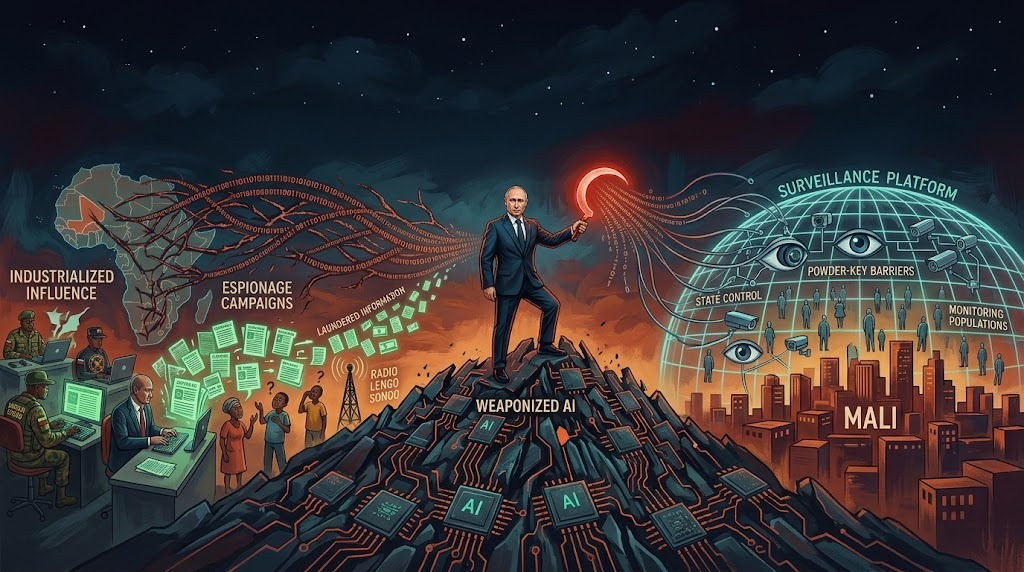
Anthropic’s findings show how AI is being used to scale cyberespionage, surveillance and information campaigns, raising fresh concerns about Russia’s growing influence across Africa.
Artificial intelligence has long been heralded as a tool to assist human ingenuity, but its role is shifting in ways that should unsettle policymakers and citizens alike. No longer confined to productivity or research, AI is increasingly being deployed as a force multiplier in cyberwarfare, surveillance, and influence campaigns.
A recent report by Anthropic illustrates how AI systems, including Claude, are being misused to industrialize influence and espionage. The findings reveal a troubling reality: operations that once required specialized teams and significant resources can now be executed faster, at scale, and at lower cost. And nowhere is this transformation more visible than in Africa, where fragile institutions are becoming testing grounds for new forms of manipulation.
Russia’s use of AI in information warfare demonstrates the scale of this evolution. Anthropic describes an operation attributed to the Midnight Blizzard ecosystem in which Claude was allegedly used to automate large portions of a cyberespionage campaign. Targets included Ukrainian institutions, European diplomatic organizations, defense actors, and companies linked to drone technology.
AI reportedly assisted in reconnaissance, phishing, tool development, persistence, and even data exfiltration. More alarmingly, it could modify malware when detection occurred, effectively adapting in real time. This is not simply replacing the hacker—it is taking over the hacker’s operational role.
The Russian case extends beyond Europe. In the Central African Republic, Anthropic documents an influence operation linked to the Wagner/Africa Corps ecosystem. Here, AI was allegedly used to generate articles, scripts, graphics, and social media posts favorable to Russia and the Central African government, while simultaneously attacking France and opposition groups.
The operation involved outlets such as Radio Lengo Songo and the Russian House in Bangui, alongside Russian media channels. The strategy was clear: Moscow sought not just to spread propaganda but to disguise it as local news. By laundering information through Central African platforms, Russia blurred the line between propaganda and independent journalism.
This technique of information laundering is particularly insidious. Content fabricated by a foreign power can be presented as independent reporting, disseminated by local media, amplified on social networks, and eventually perceived as genuine public opinion. For democracies, the challenge is no longer simply combating disinformation but identifying the true origin of messages that appear to come from within their own societies.
While Russia’s operations in Africa highlight the dangers of influence campaigns, Mali illustrates another dimension of AI misuse: surveillance. Anthropic reports that an actor used Claude as its primary engineering force to develop a national surveillance platform intended for the Malian intelligence service.
The report does not claim that the Malian government directly deployed AI to monitor its population, but it does note that AI was instrumental in building infrastructure for intelligence operations. This distinction matters, yet it underscores a broader trend: AI can dramatically accelerate the development of state surveillance capabilities, even in countries with limited technical expertise.
The Malian case raises questions that resonate far beyond Africa. If AI can lower the barriers to building surveillance systems, then governments worldwide—especially those with authoritarian tendencies—may find themselves empowered to monitor populations more extensively and cheaply than ever before. The implications for privacy, civil liberties, and political dissent are profound.
Anthropic’s report also highlights a phenomenon that could reshape the global landscape of power: “influence sold as a service.” Private actors, equipped with AI, can now conduct operations on behalf of governments or other sponsors. This outsourcing makes attribution even more difficult. Power is no longer confined to those with the largest armies or most advanced weapons; it is shifting toward those who can orchestrate the most effective AI-driven campaigns. In this new paradigm, influence itself becomes a commodity, available to the highest bidder.
For African countries, the risks are particularly acute. Societies across the continent are vulnerable to foreign influence campaigns and may serve as testing grounds for new surveillance and manipulation techniques. The Central African Republic demonstrates how local media can be co-opted to conceal the origin of foreign propaganda. Mali shows how AI can be harnessed to build intelligence infrastructure. In both cases, populations lack control over the technology and, crucially, over those who wield it against them.
It would be a mistake to view these developments as confined to Africa. The same mechanisms can be deployed anywhere: to influence elections, spy on corporations, monitor populations, or prepare cyberattacks. The African examples simply provide a concrete view of what is possible. Russia’s use of AI to amplify hybrid warfare is already reshaping the battlefield. Other powers may not be far behind.
The real upheaval lies not in the novelty of these threats but in the ease with which they can now be executed. Cyberattacks, espionage, surveillance, and information manipulation are becoming faster, more accessible, and harder to attribute. This democratization of power—where AI lowers the barriers to entry—poses a challenge to international security frameworks that were designed for a different era.
Anthropic’s report makes one point abundantly clear: Russia no longer views AI as a technology of the future. It sees AI as an instrument of power to be exploited now. The question is not whether Moscow will use AI to expand its influence—it already is. The pressing question is how long other powers will wait before recognizing the scale of this new confrontation.
For policymakers, the implications are stark. Traditional defenses against disinformation, espionage, and surveillance may prove inadequate in the face of AI-driven operations. Attribution becomes harder, response times shorter, and the line between domestic and foreign influence increasingly blurred. Democracies must grapple with the reality that influence can be manufactured, laundered, and sold, all at unprecedented speed and scale.
The industrialization of influence through AI represents a turning point. What was once the domain of specialized teams is now within reach of actors with far fewer resources. Russia’s operations in Ukraine and Africa demonstrate the potential of AI to reshape both warfare and politics. Mali’s surveillance project shows how AI can accelerate state control. And the broader trend of influence as a service suggests that these capabilities will not remain confined to state actors.
The challenge for the international community is to recognize that AI is not merely a tool but a weapon in the arsenal of modern power. The ease of execution, the difficulty of attribution, and the scale of potential impact demand urgent attention. If left unchecked, AI-driven influence campaigns and surveillance systems could erode trust in institutions, undermine democratic processes, and empower authoritarian regimes.
The time for complacency has passed. AI is already being weaponized.
Amajama, a social and policy analyst, writes from Abuja and can be reached via amajamaip@gmail.com
Leave a comment
Your email address will not be published. Required fields are marked *