

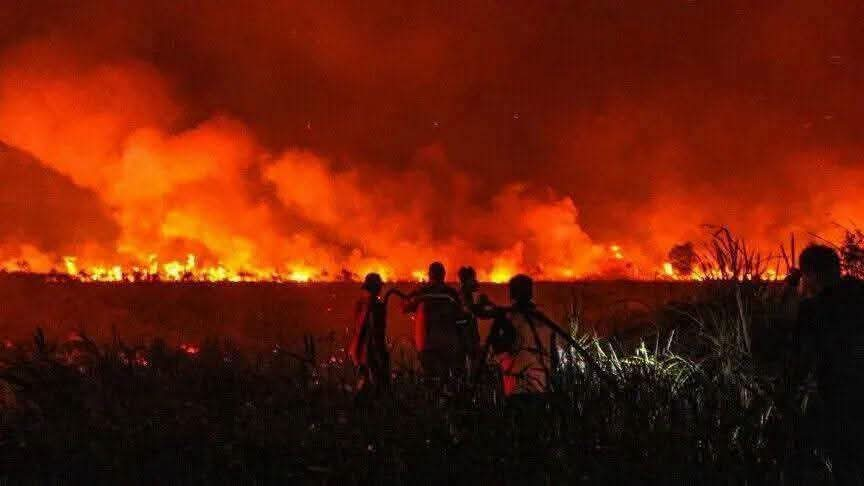
Thick haze and the strong smell of burning vegetation have worsened air quality in Banjarbaru, South Kalimantan, as fires continue to affect peatlands and forests around the city.
Smoke from recent land and forest fires has severely worsened air quality in Banjarbaru, South Kalimantan, Indonesia, with thick haze and the persistent smell of burning vegetation making breathing uncomfortable for residents and visitors.
An eyewitness travelling from Banjarmasin to Banjarbaru reported significantly poorer air quality on entering the city, with a white haze visible along much of the route.
The smell of smoke remained noticeable even while wearing a high-filtration mask, underscoring the intensity of the pollution in affected areas.
The haze was also visible in residential neighbourhoods, where some residents wore masks while others continued with their daily activities without respiratory protection.
Although visibility remained manageable during the morning, dense smoke in some areas can reduce visibility to between five and 10 metres, creating additional risks for motorists and other road users.
At about 6:30 a.m. local time, signs of recent burning were observed in the Guntung Payung area, where sections of a narrow peatland tract appeared badly charred.
White smoke continued to rise from the blackened ground, suggesting that fires could still be smouldering beneath the surface.
The fires have affected an estimated 1,263 hectares (3,120 acres) of land and forest around Banjarbaru, the capital of South Kalimantan, over the past two months.
Some of the worst-affected areas are reportedly located near the city’s international airport and surrounding protected forests, raising concerns about the impact of the fires on air quality, transportation and nearby communities.
The continuing fires highlight the persistent threat posed by peatland and forest fires in the region. Peat fires can be particularly difficult to extinguish because flames and heat can continue underground, producing smoke even after visible flames have disappeared.
For residents, the immediate concern remains the deteriorating air quality, while reduced visibility could pose additional hazards for people travelling through smoke-affected areas.
The persistent haze also underscores the broader environmental and public-health challenges associated with land and forest fires, particularly in areas where peatlands are vulnerable to prolonged burning.
Leave a comment
Your email address will not be published. Required fields are marked *