

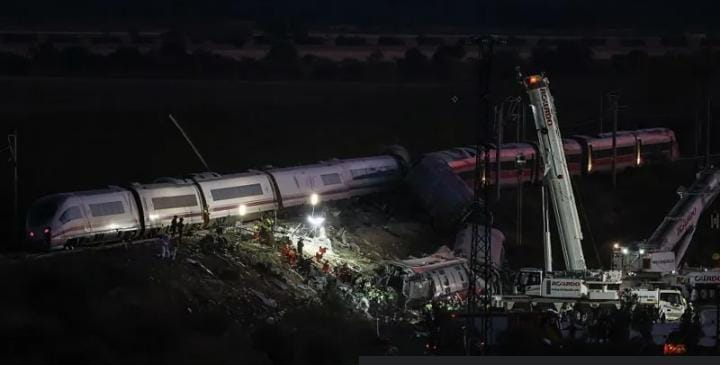
Investigators are examining a suspected rail control failure after a high-speed train struck a stationary passenger train, triggering a major rescue operation and protests over railway safety.
Spain has begun three days of national mourning after at least 68 people were killed and dozens injured in a devastating train collision near Urda, Toledo.
This is one of the country’s deadliest rail disasters in decades.
Emergency crews worked through the night on Wednesday under powerful floodlights, cutting through twisted metal and clearing debris as authorities searched for victims and tried to identify the dead.
The crash occurred shortly before 09:00 on Wednesday when a high speed train operated by state owned Renfe, carrying 397 passengers, struck the rear of a stationary train run by private operator Iryo, which had 147 passengers on board.
The impact derailed several carriages, sending some down an embankment.
Survivors described scenes of panic, with passengers trapped in their seats, people bleeding and smoke filling the carriages, one of which caught fire.
Authorities are investigating what led to the collision.
Transport Minister Óscar Puente said the Iryo train had stopped because of a computer failure, after which a control centre in Madrid reportedly instructed the trains to move again without speed restrictions.
ALSO READ: DRC Ebola Outbreak Surpasses 10,000 Cases as Death Toll Nears 5,000
https://dailyobserver.ng/drc-ebola-outbreak-surpasses-10000-cases-as-death-toll-nears-5000
Audio recordings between controllers and drivers appear to indicate that a high-speed train received clearance to proceed despite another train being stalled ahead. Investigators are examining the sequence of events as recovery and identification efforts continue.
Prime Minister Pedro Sánchez said the disaster had left the country grieving, declaring that lives have been shattered, families have been torn apart, the pain is immense.
The tragedy has also intensified concerns about
railway safety, coming months after a separate high-speed train crash near Córdoba killed 46 people in January.
Opposition leader Alberto Núñez Feijóo called for answers, saying Spain had the right to know what was happening with its infrastructure.
Public anger spilled onto the streets of Madrid on Wednesday night, when around 1,500 people reportedly gathered outside the Transport Ministry to demand accountability, with some calling for the resignations of Sánchez and Puente.
Police used tear gas after protesters threw bottles and flares, although no injuries or arrests were reported.
Most political parties suspended election campaigning, while far-right Vox leader Santiago Abascal rejected what he described as attempts to use national mourning to silence criticism of the rail network.
Meanwhile, Spain’s Civil Guard has established missing-persons reporting centres in Madrid, Toledo, Seville and Córdoba, prioritising victim identification and the collection of DNA samples to reunite families with their loved ones.
Railway drivers are also expected to proceed with a planned strike in defence of rail safety.
The European Commission has lowered EU flags to half-mast in solidarity with Spain, as the country confronts its deadliest rail disaster since the 2013 crash near Santiago de Compostela that killed 80 people.
Leave a comment
Your email address will not be published. Required fields are marked *