

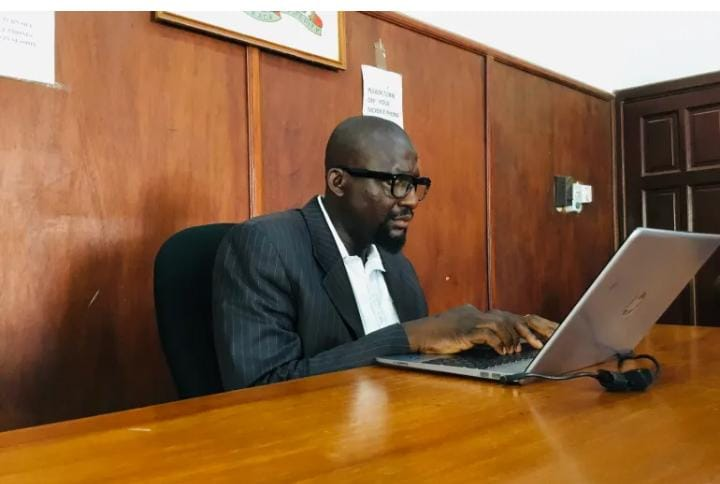
Muhammed Krubally has presided over more than 1,000 cases since joining the judiciary in 2016, but his career highlights the wider struggle for disability inclusion in education, employment, and public institutions.
At the Banjul Magistrates’ Court in The Gambia, Magistrate Muhammed Krubally relies on sound, memory and assistive technology to navigate proceedings and deliver justice.
The 41-year-old became the country’s first visually impaired magistrate in 2016 and says he has handled more than 1,000 civil and criminal cases. Using the JAWS screen reader and AI-enabled smart glasses, he accesses digital documents and court information while working to ensure that his visual impairment does not limit his professional responsibilities.
Krubally’s journey began in a village in the Central River Region, where he grew up as the second of nine children.
Despite facing limited educational resources and discouragement from some teachers and fellow students, he pursued his ambition of becoming a lawyer.
He says those experiences strengthened his determination to advocate for people whose rights are often overlooked.
“I became a magistrate to change the system, to make it inclusive,” he said.
His achievement comes against a backdrop of continuing barriers for people with disabilities in The Gambia.
The country’s Persons with Disabilities Act, passed in 2021, provides for non-discrimination, accessibility, equal opportunities, and access to justice.
However, the National Human Rights Commission has identified persistent challenges in education, employment, and access to public services.
The Ministry of Gender, Children, and Social Welfare did not respond to Al Jazeera’s questions about the implementation of the law.
Education remains a major concern. The Gambia Organisation of the Visually Impaired operates a resource centre serving 49 pupils aged four to 14, according to its head, Lamin Colley. But limited learning materials and insufficient specialist teachers are making it difficult to support pupils transitioning into mainstream schools. Colley said little had changed on the ground since the disability law was enacted, pointing to what he described as inadequate government funding for disability-related needs.
Other professionals face similar challenges even after gaining positions in public institutions.
Ndey Yassin Secka-Sallah, a visually impaired former National Assembly member and disability rights advocate, said she depended on colleagues to follow parliamentary proceedings because she lacked the tools to participate independently. Musa Barrow, a visually impaired media law lecturer, said technology had helped him prepare lessons and work more independently, although he continued to encounter doubts about his professional abilities.
Krubally now mentors young people with visual impairments, encouraging them to pursue their ambitions.
His career demonstrates what assistive technology and determination can make possible, but it also raises questions about whether institutions are doing enough to accommodate people with disabilities.
For Krubally, the future remains one of possibilities, but achieving genuine inclusion will require more than individual success.
Leave a comment
Your email address will not be published. Required fields are marked *