

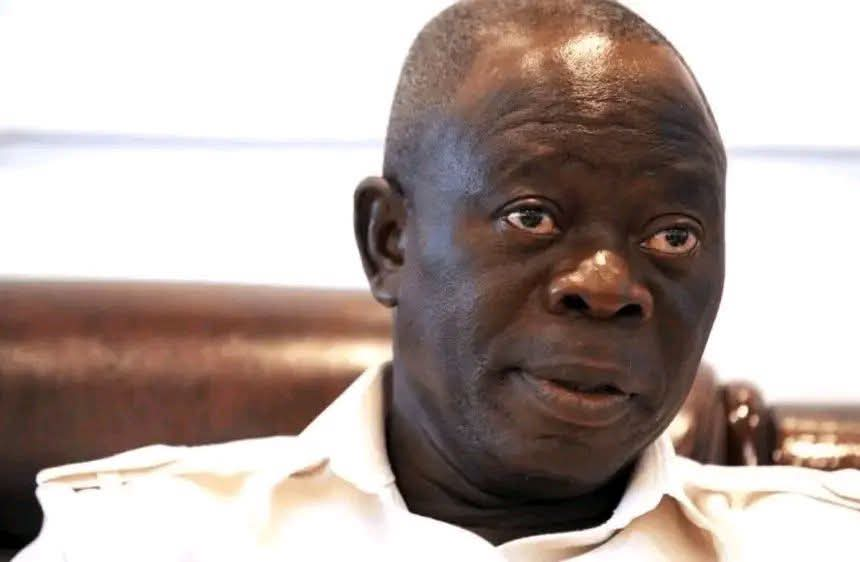
The former Edo governor questions how Obi accumulated the reported foreign currency savings while Anambra received federal allocations in naira, and argues that World Bank facilities should count as loans.
Senator Adams Oshiomhole has challenged former Anambra State Governor Peter Obi to explain how he allegedly accumulated $156 million in savings during his eight-year administration, questioning the source of the funds and disputing his claim that he left office without borrowing.
Oshiomhole, who represents Edo North Senatorial District and previously served as governor of Edo State, raised the questions during an interview, arguing that the reported dollar savings needed to be reconciled with the currency in which the Federal Government disbursed allocations to states.
The senator, a former national chairman of the All Progressives Congress (APC), said he and Obi were members of the National Economic Council, chaired by the vice president, when state governors sought permission to receive their federal allocations in dollars.
According to Oshiomhole, the request was driven by the disparity between the official exchange rate and the parallel market rate at the time. However, he said the Federal Government rejected the proposal, insisting that the naira remained Nigeria’s official currency.
He questioned how Obi could have accumulated substantial dollar savings if Anambra State received its allocations in naira.
“So all the allocations we receive are in naira. So I asked Obi, where did you get dollars to save? Did you receive naira from Abuja and go to bid for dollars to save for Anambra State?” Oshiomhole asked.
The senator questioned the explanation surrounding the alleged savings and maintained that Obi’s financial record required further scrutiny.
He also cited Anambra State Governor Chukwuma Soludo, a former governor of the Central Bank of Nigeria (CBN) and an economist, arguing that Soludo was well-positioned to explain the financial issues surrounding Obi’s tenure.
“If you know Soludo, I think you should accept that when it comes to financial questions, Soludo is the authority,” Oshiomhole said.
Oshiomhole disputes Obi’s claim of leaving office without loans
Beyond the controversy surrounding the reported dollar savings, Oshiomhole challenged Obi’s assertion that he did not borrow money while governing Anambra State from 2006 to 2014.
The senator argued that financial facilities obtained from the World Bank could still constitute loans, even where repayment was deferred or subject to a moratorium.
Drawing from his own experience as Edo governor, Oshiomhole said he accessed World Bank funding, including facilities commonly described as budget support.
He argued that the timing of repayment did not change the underlying nature of the financial obligation.
“They are loans. But he then went on to say that these are not loans you pay immediately. Because you are not paying it immediately, it’s not a loan?” he queried.
Oshiomhole maintained that such obligations remained on the books and could eventually become the responsibility of a succeeding administration.
“It’s in the books. And a future government will necessarily pay it anyway,” he said.
According to the senator, repayment moratoriums can allow an administration to complete its tenure before some obligations fall due, leaving a successor government to handle the repayments.
“Your tenure will have ended before the day you become mature for repayment,” he said.
Oshiomhole argued that this was the kind of financial arrangement he believed Soludo had sought to explain in discussions about Obi’s record.
Senator questions DMO recognition claim
Oshiomhole also disputed Obi’s account of an event organised by the Director-General of the Debt Management Office (DMO), which the former Anambra governor reportedly cited as recognition for not seeking loan approvals.
The senator dismissed the account as “another lie”. However, he did not provide further details in the interview excerpt to substantiate the allegation.
Obi maintains he left Anambra without debt
Obi, who governed Anambra State between 2006 and 2014, has consistently maintained that he left the state in a sound financial position and did not saddle it with debt.
He reiterated his position during a recent appearance on Arise Television, where he responded to allegations that his administration left outstanding loans and other financial liabilities.
However, Anambra State Commissioner for Information and Value Reorientation, Law Mefor, had previously alleged that Obi left behind $123.77 million in debt at the end of his tenure.
The competing claims have added to the debate over the former governor’s management of public finances, particularly the distinction between savings held in foreign currency, borrowed funds and outstanding financial obligations.
While Oshiomhole has questioned the source of the reported dollar savings and argued that deferred World Bank facilities should be recognised as loans, the figures and allegations remain contested in the public debate.
The controversy also highlights a broader political question about how the financial records of former state administrations should be assessed, including how savings were accumulated, which liabilities remained outstanding and whether repayment obligations were transferred to subsequent governments.
As political exchanges over Obi’s record continue, the central issues remain the verification of the reported savings, the nature of the alleged loans and the financial position Anambra State inherited at the end of his administration.
Leave a comment
Your email address will not be published. Required fields are marked *